

Last Wednesday at Connect, Mark Zuckerberg walked on stage in a T-shirt that read BUILDING IS MY LOVE LANGUAGE (🙃) and held up a keychain with a face on it.
It’s called the Muse Charm. It has a little screen, a fingerprint sensor, and a cutesy, Pixar-esque character called Jolly, who is your AI agent. Press the button, have a chat, and Jolly toddles off to book your train, answer your emails and buy the thing you mentioned in passing. You can design your own version of the character, and soon you’ll be able to video call it. It ships in December, just in time for Christmas, which I’m sure is a complete coincidence.
Until last week, an AI agent was a chat window, or a browser tab quietly doing your admin while you made a cup of tea. Now it’s a character. It has a name and a face, and it dangles off your bag like a Tamagotchi. It has been designed, with enormous care, to be adorable. It's something you carry around, get attached to and trust. Which is exactly how you'd want people to feel about your agent if you were planning to make money from what it buys.
And Meta is. Muse launched three weeks ago, went straight to the top of the App Store and has passed two and a half million downloads. It's free for most people, most of the time. And Zuckerberg explained why: over time, Meta plans to take a small fee from the transactions. So the little character choosing your sunglasses gets a cut of the sunglasses purchase (Jolly, it turns out, is on commission).
Cue the conversations about agents coming roaring back: what they’ll do to brands, to agencies, to how people shop, and how fast it’s all arriving. Which sent me back to a talk I gave at the IAA last November, to a room of agency people who were very gracious about being told their business model had a definitive shelf life.
It was called The Identity Shift and it followed a woman called Jenny through a day in 2027. Her agent bought her a belt for a client meeting, did her food shop and nudged her towards a pottery class she’d never once mentioned. The argument was that the relationship between brands and customers was about to start running through agents. Those agents would read your data rather than your ads and check your claims against what you actually do and the value you provide. And somewhere in all of it, the business of deciding what Jenny wants and who Jenny is would quietly drift out of Jenny’s hands.
A year is a long time in AI, so I reread it braced to wince at myself. I mostly didn’t. So I’m taking the win.
Though in hindsight, I would sharpen two things. I said the agent works for the customer, not the brand. And in truth, it works for whoever owns it. When the owner earns a percentage of the basket, Jenny’s interests and the platform’s interests start to drift apart, and she has no way of knowing which one is doing the choosing.
I also asked whether brands could survive as identity markers once agents were choosing on our behalf. I didn’t see Meta’s answer coming, which is to make the agent itself the identity marker. You design it, you name it and you clip it to your bag (twenty-odd years in this industry and I still underestimated our ability to turn anything into merch).
The bit people could pick at is checkout. The talk pointed to Walmart and Shopify arriving in ChatGPT, and by March OpenAI had rolled Instant Checkout back with about a dozen Shopify merchants live. The reasons were thoroughly unglamorous. OpenAI hadn’t built a way to collect US sales tax and had no interest in becoming the shop, with all the liability that brings. It also found that stitching together millions of product catalogues, each with its own conventions, was too much, too soon. The protocol it built with Stripe is still there.
Walmart’s number is the one I keep coming back to. Purchases completed inside ChatGPT converted at about a third of the rate of sending the same people to Walmart’s own site. People were happy to let the agent find things, but when it came to handing over money, they wanted a logo they recognised. Meta’s answer to this trust chasm is Jolly. It might work.
So here’s the talk as I gave it. The dates and figures are as they stood in early November 2025, so “three days ago” means the week ChatGPT Atlas launched. I haven’t tidied it up. Each section ends with questions for the agencies in the room.
I’d love to tell you we’ve answered them since then, but alas…
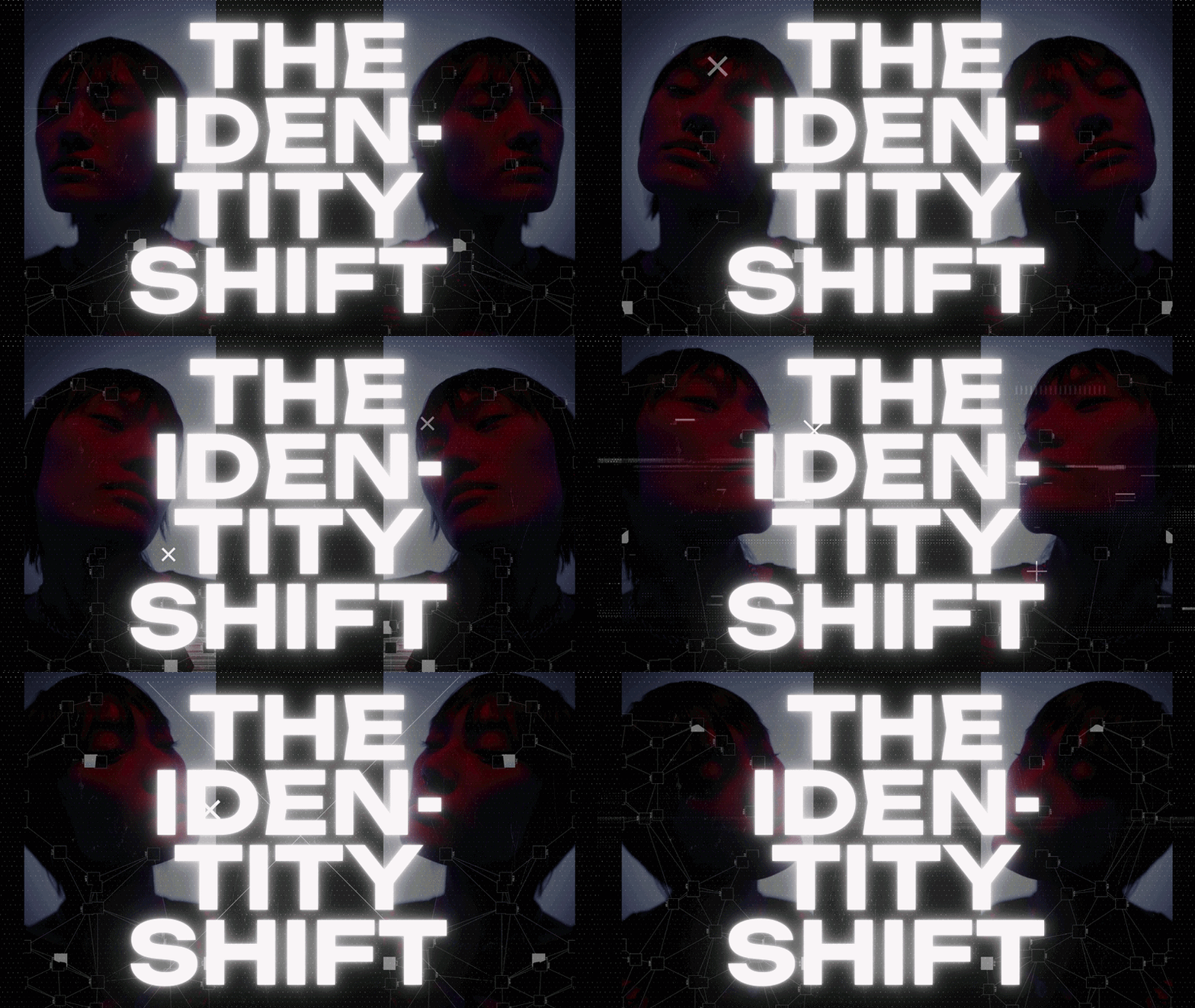
Marketing has a complex relationship with identity, functioning in two ways:
- Identity as a Product: Brands serve as self-expression tools, with purchases reflecting personal identity (e.g., owning a Mac or wearing Patagonia).
- Identity as Targeting: Marketers use identity traits to segment audiences and deliver tailored messages, fostering communities around shared values (e.g., Nike runners, outdoor enthusiasts).
This system is based on the belief that identity is shaped by individual choice. However, this assumption is increasingly being challenged.
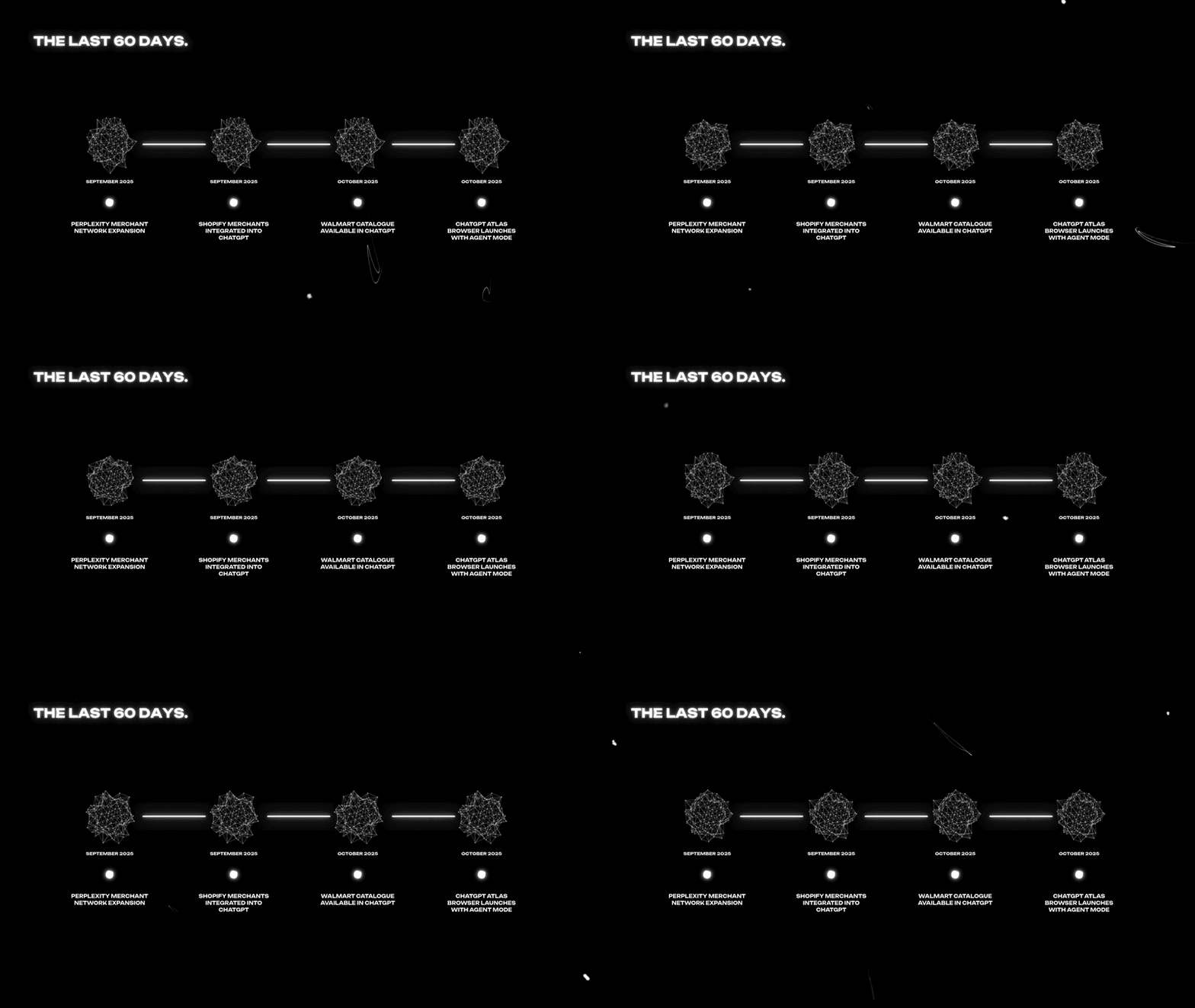
In the past few weeks, significant advancements in AI-mediated commerce have occurred:
- OpenAI launched ChatGPT Atlas, a browser where AI logs your online interactions and can autonomously complete tasks.
- Walmart made its entire catalog shoppable through ChatGPT.
- Shopify integrated millions of merchants into a conversational layer.
- Perplexity expanded its merchant network, making thousands of brands shoppable via AI conversation.
These four major launches reflect a coordinated transformation in how mediated commerce operates.

Let me show you what I mean.
It’s 2027. Jenny is 28, works in marketing, lives in Manchester.
She opens her wardrobe and her AI agent immediately suggests three outfit combinations, then notes: “Your black blazer would be perfect for the 2 PM client meeting, but you need a statement belt to complete the look.”
Within seconds, it’s ordered. The perfect belt based on her style profile, budget, and sizing data. Drone delivery: 15 minutes.
Later, she says: “I need a recipe for tonight.” The agent doesn’t just suggest Spaghetti Bolognese—it adds specific ingredients to her shopping cart, choosing brands based on her dietary restrictions, budget parameters, and past satisfaction data, then schedules delivery for 6 PM.
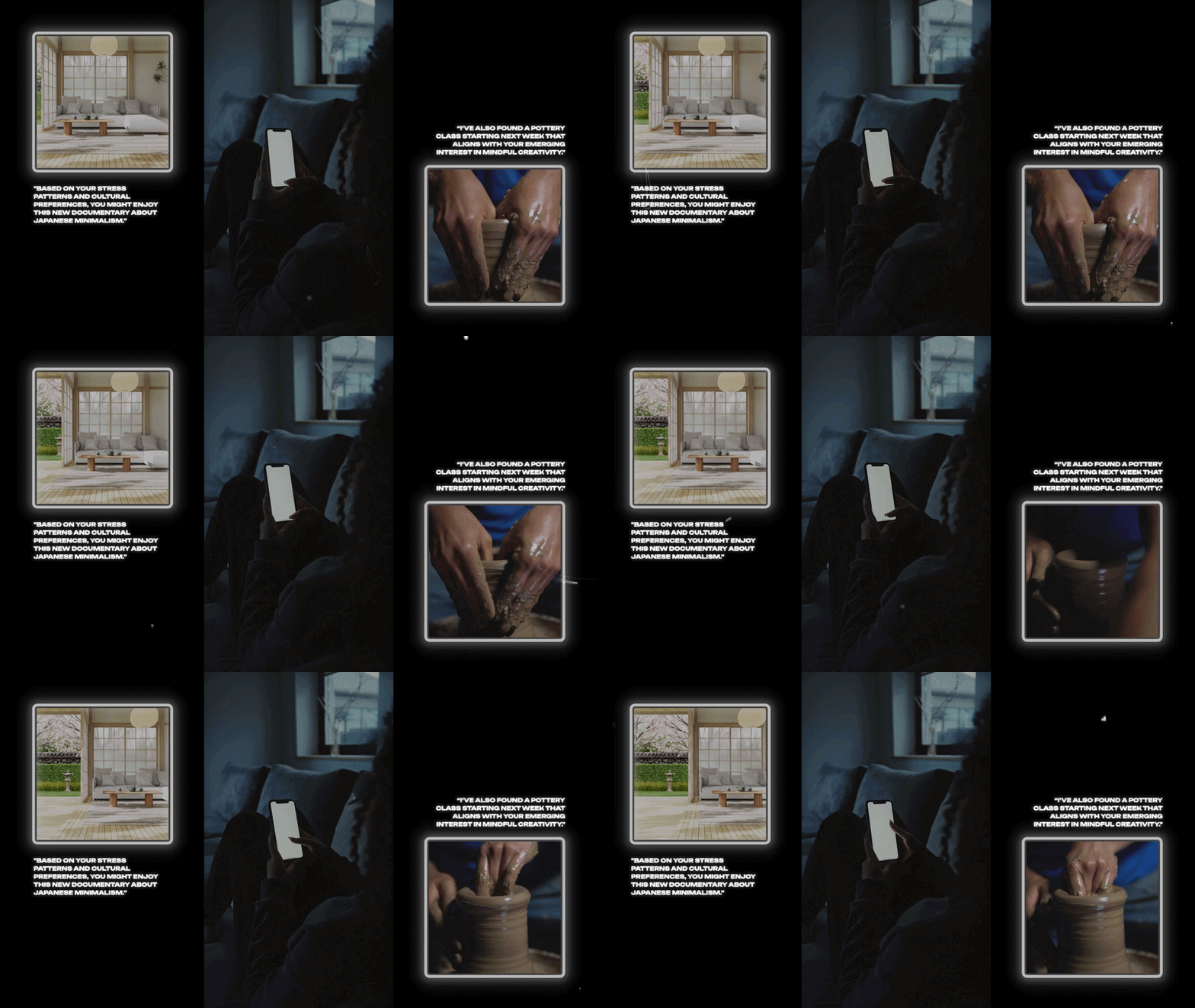
That evening, Jenny expresses restlessness, and the agent suggests mindfulness or pottery, despite her never mentioning interest in these.
The agent detected patterns in her choices, making Jenny feel understood, yet it reflects how her identity is shaped by systems optimising for outcomes she never consciously selected.

When Jenny’s agent selected that specific belt brand, chose those particular tomatoes, and suggested Japanese minimalism as her next cultural interest, it made decisions that traditional marketing could never have influenced.
The agent operated in a black box, using criteria no brand fully understands.
This is the future of commerce, culture, and identity formation. And it’s arriving faster than most businesses are prepared for.
What Jenny experienced demonstrates three strategic challenges that are reshaping how businesses must approach value creation, customer relationships, and competitive positioning.
Let’s begin with the initial challenge: the interface.
Before anything else, we must grasp the scale of AI agent usage.
who is using these agents, how fast adoption is growing, and how human behavior is changing. The statistics may be surprising.
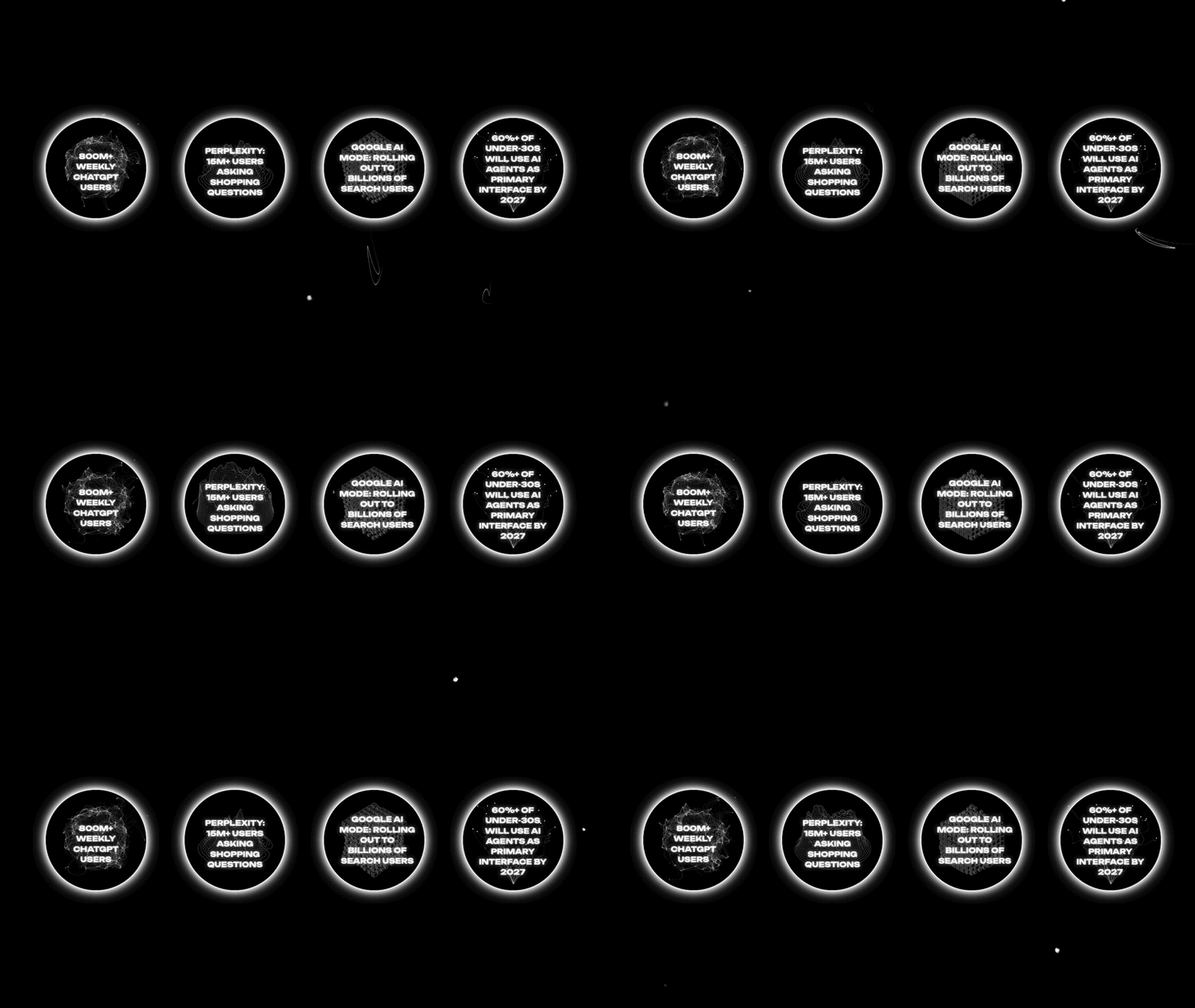
Let’s talk about who’s actually using this, because it’s not a niche experiment.
Conversational commerce queries are growing 300% year-over-year. People are already asking AI “find me workout clothes for hot yoga that don’t show sweat” instead of typing “women’s athletic wear” into a search box.
The behaviour is already changing. The scale is already meaningful. And the agent is increasingly the gatekeeper between businesses and consumers.
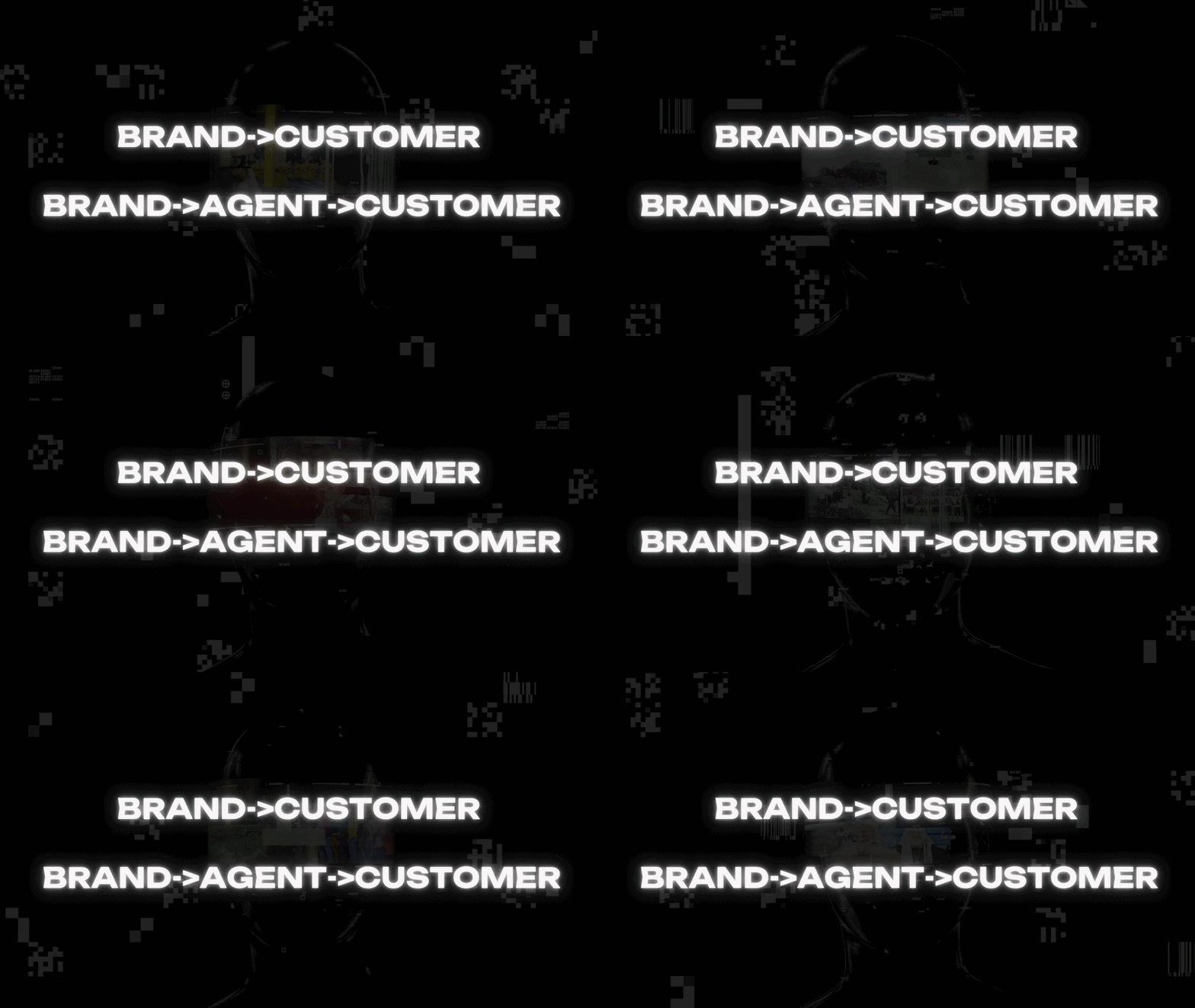
This represents a fundamental shift in how businesses connect with customers.
We’re moving from direct relationships to mediated relationships.
And the agent is optimising for the customer, not for you.

Here’s what makes this moment different from every other platform shift we’ve seen.
Three companies starting from completely different places are all racing toward the same destination.
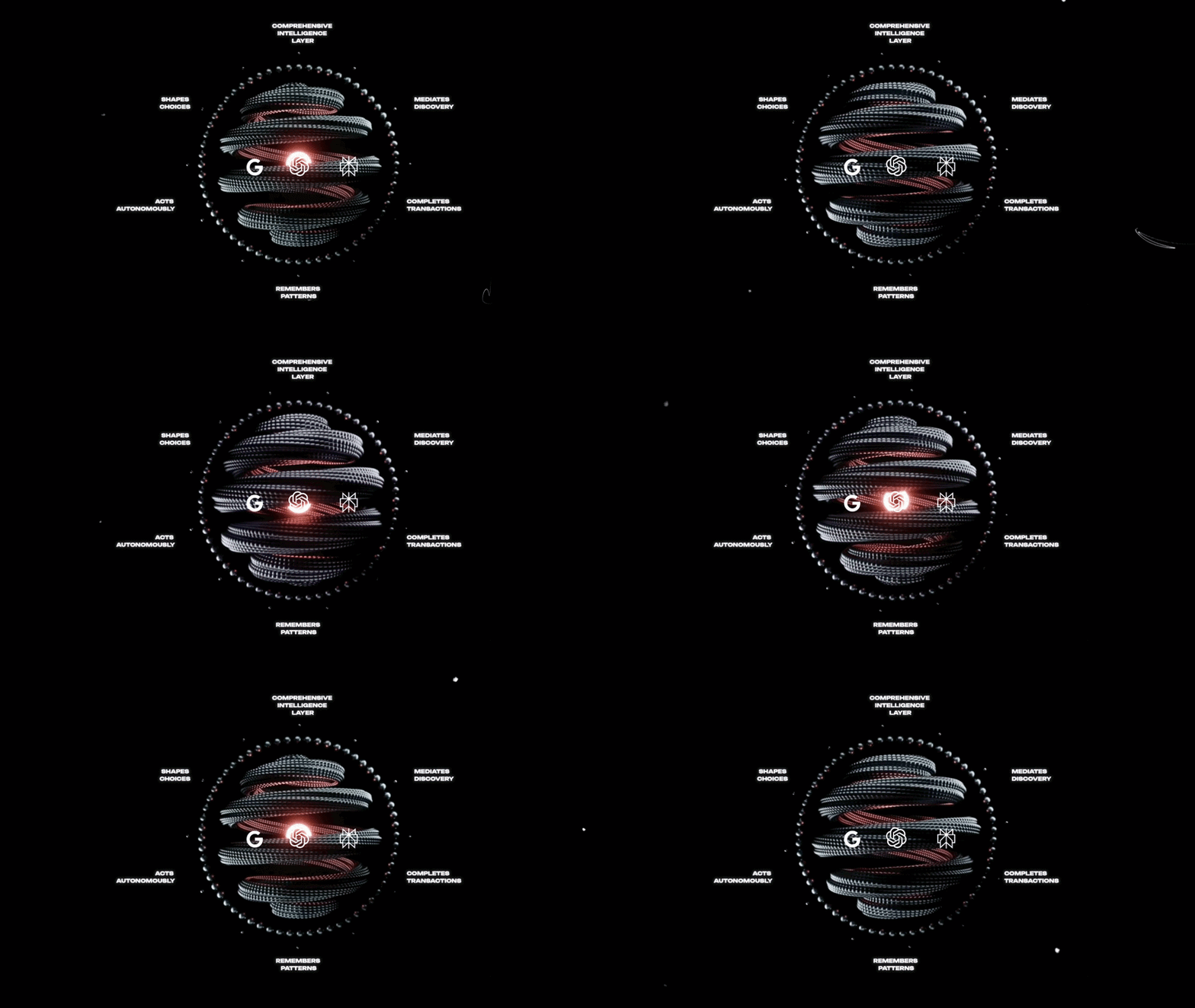
Three different starting points. All converging on the same model: a comprehensive intelligence layer.
When Jenny opens any of these platforms, she’s entering an environment where AI sees everything, remembers patterns, suggests moves, completes tasks, and quietly guides what she discovers about herself and decides upon.
This is superapp intelligence. And every major player is building it simultaneously from different directions.
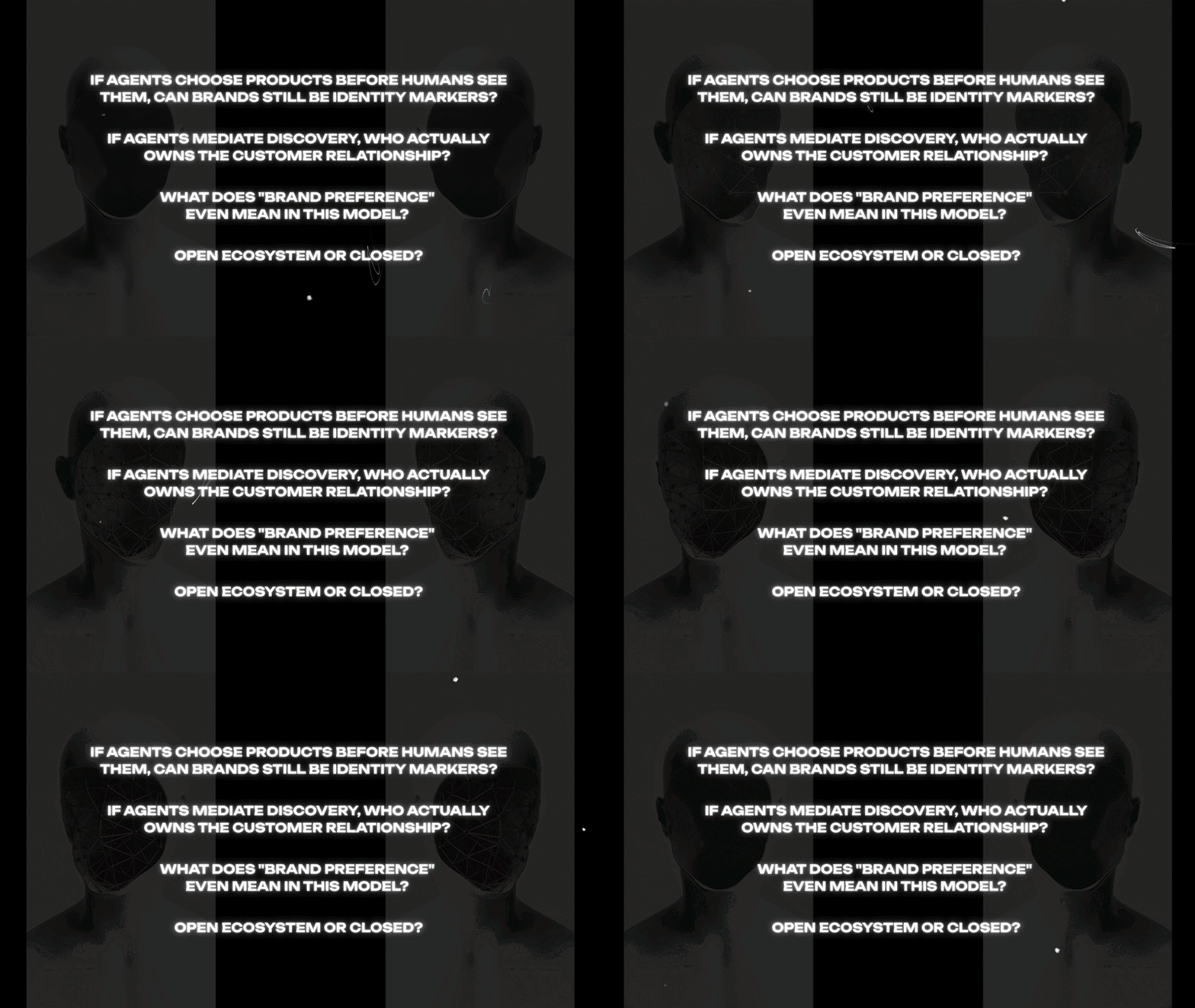
Remember how we started this conversation? Marketing has two fundamental relationships with identity: we build brands that become identity markers, and we use identity understanding to target and serve customers better.
Both of these are being disrupted simultaneously.
This creates new questions.
.........
These questions get at something profound: the entire discipline of marketing was built on direct access to human psychology and choice.
That access is being mediated. And we’re still figuring out what marketing even means in that world.

So we’ve established the interface challenge: agents are becoming the gatekeepers between you and customers.
The natural response is: “How do we get discovered by these agents? How do we influence what they recommend?”
And that leads us to data.
Because AI agents generate exponentially richer behavioral insights than we’ve ever had access to.
But to leverage that opportunity, you first have to solve a fundamental problem.
So let’s talk about data architecture.

AI agents generate exponentially richer behavioural data than anything we’ve had before.
It’s unprecedented. This level of conversational richness and semantics creates extraordinary business opportunities.
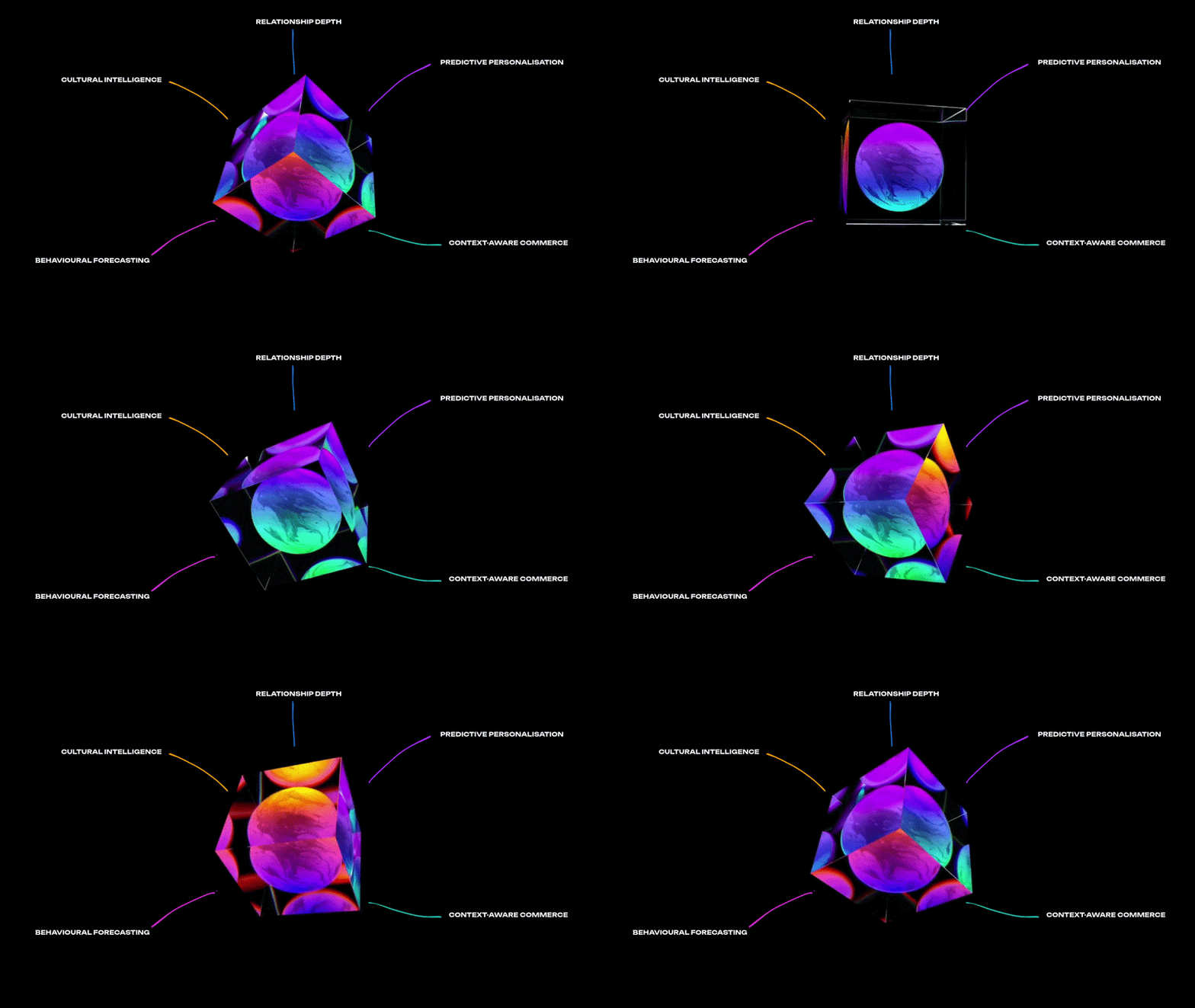
Predictive personalisation—understanding what customers will want before they know it.
Context-aware commerce—matching products to specific life moments and emotional states.
Behavioural forecasting—anticipating demand shifts based on conversational patterns.
Cultural intelligence—reading emerging trends through how customers actually speak.
And relationship depth—building genuine understanding of customer motivations and values.
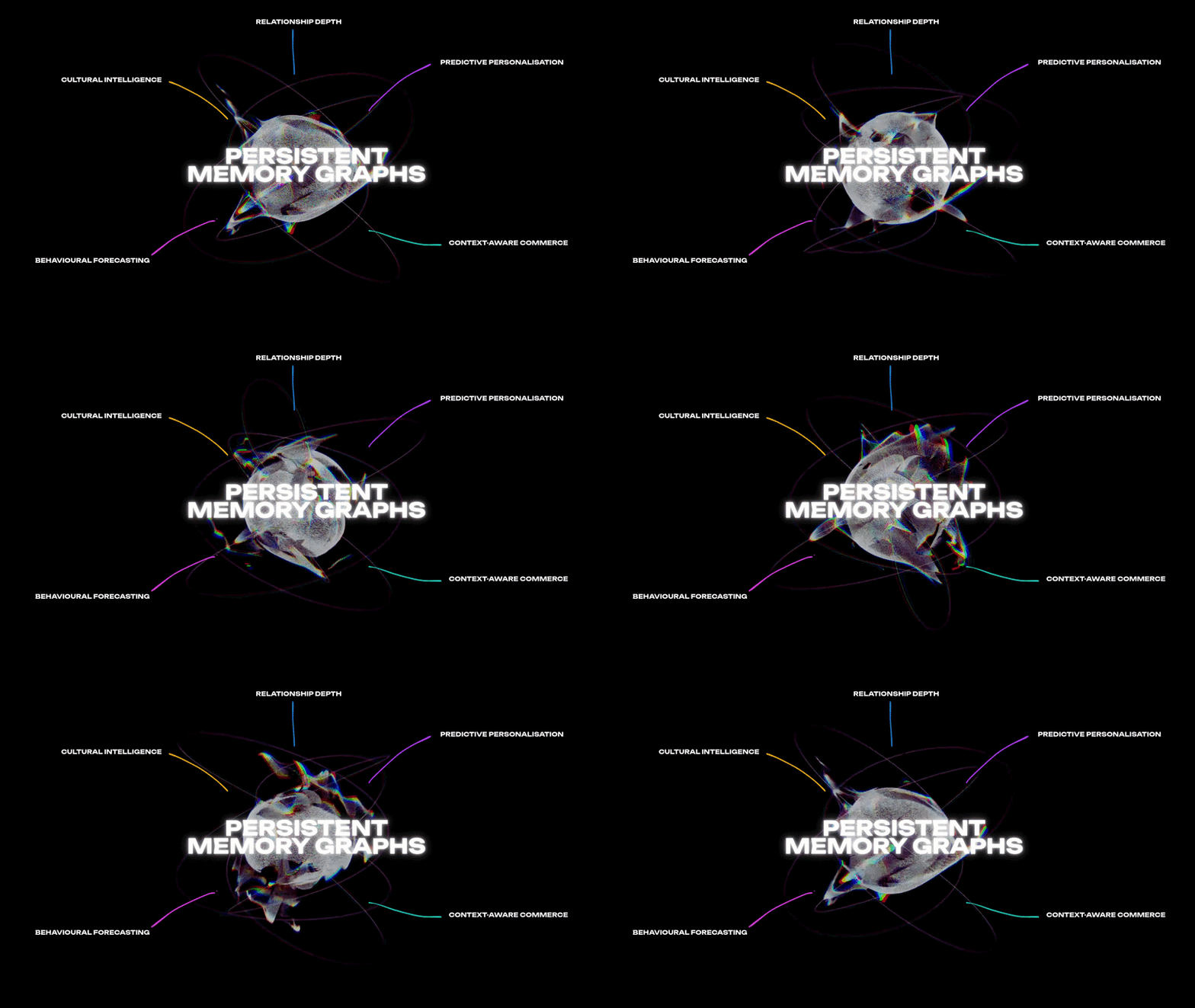
AI systems build sophisticated models—taste evolution, contextual preferences, values hierarchies, social influence patterns.
And this isn’t theoretical. ChatGPT Atlas includes “browser memories.” It builds models of your patterns over time.
These become more accurate predictors of behaviour than traditional demographics or even customers’ own self-knowledge.
The agent knows Jenny is moving toward mindful creativity before she explicitly articulates it.
It sees the pattern in her browsing, her searches, her pauses, her purchases.
This is the gold mine.
Exponentially richer behavioural insights than anything we’ve had in the history of commerce.
The business value is extraordinary
But to access any of this—to leverage these rich conversational insights, to tap into persistent memory graphs, to build predictive personalisation—you first have to solve a fundamental problem.
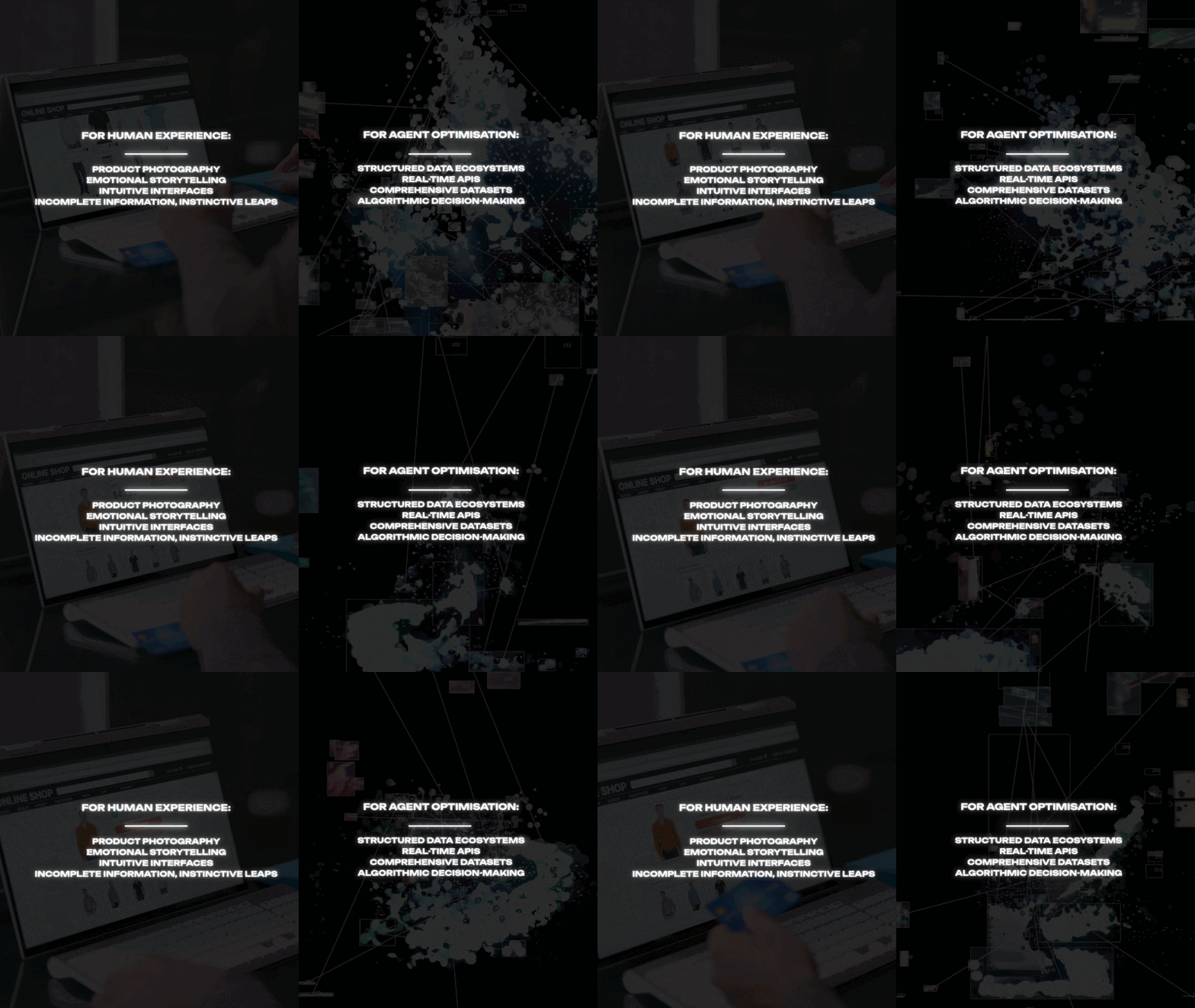
The agents can’t read what you’ve built for humans.
It’s not that machines and humans need completely different information—it’s that they need the same information optimised differently.
The critical difference: Humans can work with gaps in information and make emotional decisions based on partial data.
Agents need comprehensive, structured datasets to make optimal decisions.
When Jenny’s agent evaluates belt options, it can simultaneously process style compatibility, quality ratings, sustainability scores, delivery logistics, and contextual appropriateness—but only if that data exists in machine-readable formats.
Most brands provide enough structured data for basic e-commerce, but not the depth and real-time accuracy needed for sophisticated agent decision-making.
This is the gate: you cannot access the rich conversational insights, the persistent memory graphs, the predictive personalisation—none of the opportunity we just discussed—unless you solve dual optimisation.
Unless agents can read and process your data.
But even when you solve this, even when you build the technical infrastructure to be discovered and evaluated by agents, that raises the next fundamental question: who actually controls all this valuable data?
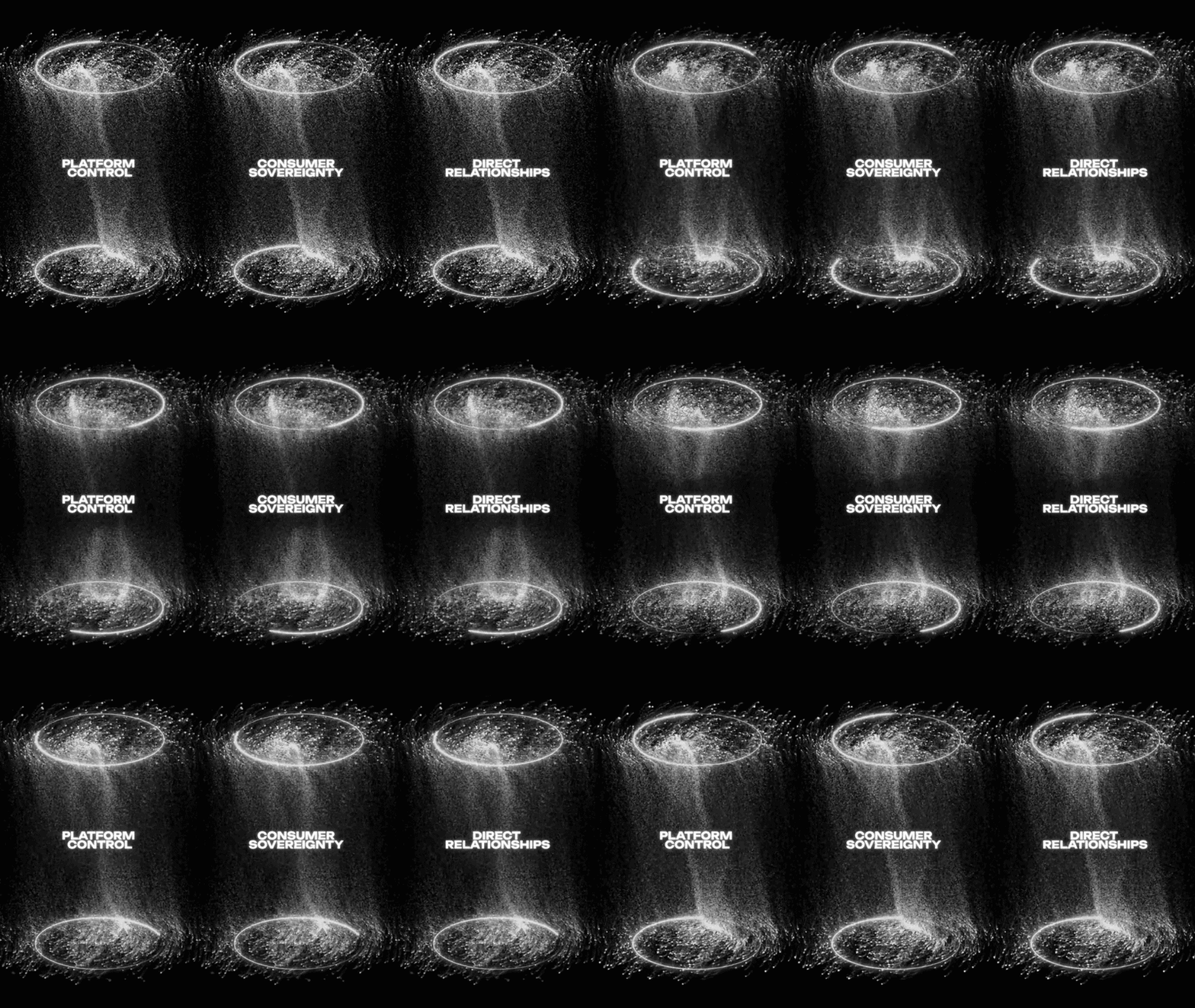
This brings us to the critical question: who owns and controls this valuable data?
The reality is that all three models will operate simultaneously.
Platform Control: Agent platforms like OpenAI, Google, Apple own conversational data and memory graphs, licensing insights back to businesses. Companies become data customers rather than data owners.
Consumer Sovereignty: Privacy primitives and zero-knowledge proofs enable consumers to maintain control over their behavioral data, choosing what to share and with whom. Businesses must negotiate access to their own customer insights.
Direct Relationships: Businesses build their own agent interfaces and maintain proprietary memory graphs through direct customer relationships. First-party conversational data becomes a competitive moat.

Each one threatens traditional first-party data collection in different ways.
When platform agents control relationships, you can’t collect behavioral data directly—OpenAI or Google owns the conversational layer.
When consumers control data through privacy primitives, they choose what to share—you have to negotiate access to insights about your own customers.
And when you build your own agent interface to maintain direct relationships, you’re competing against platform agents that have universal behavioural data from millions of users across all categories. Your proprietary graph is rich, but narrow. Theirs is comprehensive.
The result: the customer databases businesses have spent years building may become less valuable
AI-mediated behavioural intelligence fundamentally changes what constitutes competitive advantage.
This isn’t about any one model winning. It’s about navigating all three simultaneously.
This isn’t a one-time technical implementation. Agents evolve. Their data requirements change. Google’s agent needs different formats than ChatGPT’s agent needs different formats than whatever comes next. You need ongoing investment and iteration to remain accurately discoverable and properly represented. This is now a core operational capability, not a project.
When Jenny’s agent evaluates your belt options, it’s using behavioural patterns learned from millions of shopping decisions across all retailers. Your competitors’ customers are training the same agent that serves your customers. Traditional competitive moats around proprietary customer data erode when agents optimise across the entire market. So what becomes your differentiation when the AI has universal customer intelligence?
Third, what’s your strategic choreography across the three ownership models? Some of your customers will come through ChatGPT—platform owns the conversational data. Some will use privacy tools and control their own data—consumer sovereignty. Some will interact directly—you own the relationship. How do you maintain consistent customer understanding and competitive advantage when your data strategy must work across all three models simultaneously? What’s the orchestration between them?
These are operational questions you need answers to in the next 12 months.
We’ve covered the interface challenge—agents becoming gatekeepers.
We’ve covered the data challenge—who owns the behavioural insights these systems generate.
Now let’s talk about what happens when agents can verify everything.
Because here’s what we haven’t discussed yet: when AI agents mediate discovery and transactions, they don’t just read your marketing claims.
They can fact-check them. In real-time. Against every available data source.
This creates a new competitive landscape where authenticity isn’t optional—it’s technically enforced.
Let me show you what I mean.

When Jenny’s agent evaluates a brand’s sustainability credentials, it’s not limited to what you choose to tell her.
It’s pulling from government databases. Reading competitor comparisons. Analyzing patterns in customer complaint data. Watching video reviews from people who actually use your product. Cross-referencing your carbon footprint against industry benchmarks. Checking employee satisfaction scores on Glassdoor.
All of this happens in seconds. Synthesized into a coherent assessment that Jenny sees as a simple recommendation.
The gap between what you say about your business and what you actually do? That gap is now visible. Measurable. And factored into every decision agents make on behalf of customers.
You can’t curate your way out of this. The information environment is too complete.
So what does this mean for competitive strategy?
It fundamentally reorders what creates advantage.
The beautiful campaign? Still valuable. But it’s table stakes now, not differentiation.
What wins in an AI-mediated world is the company that actually delivers.
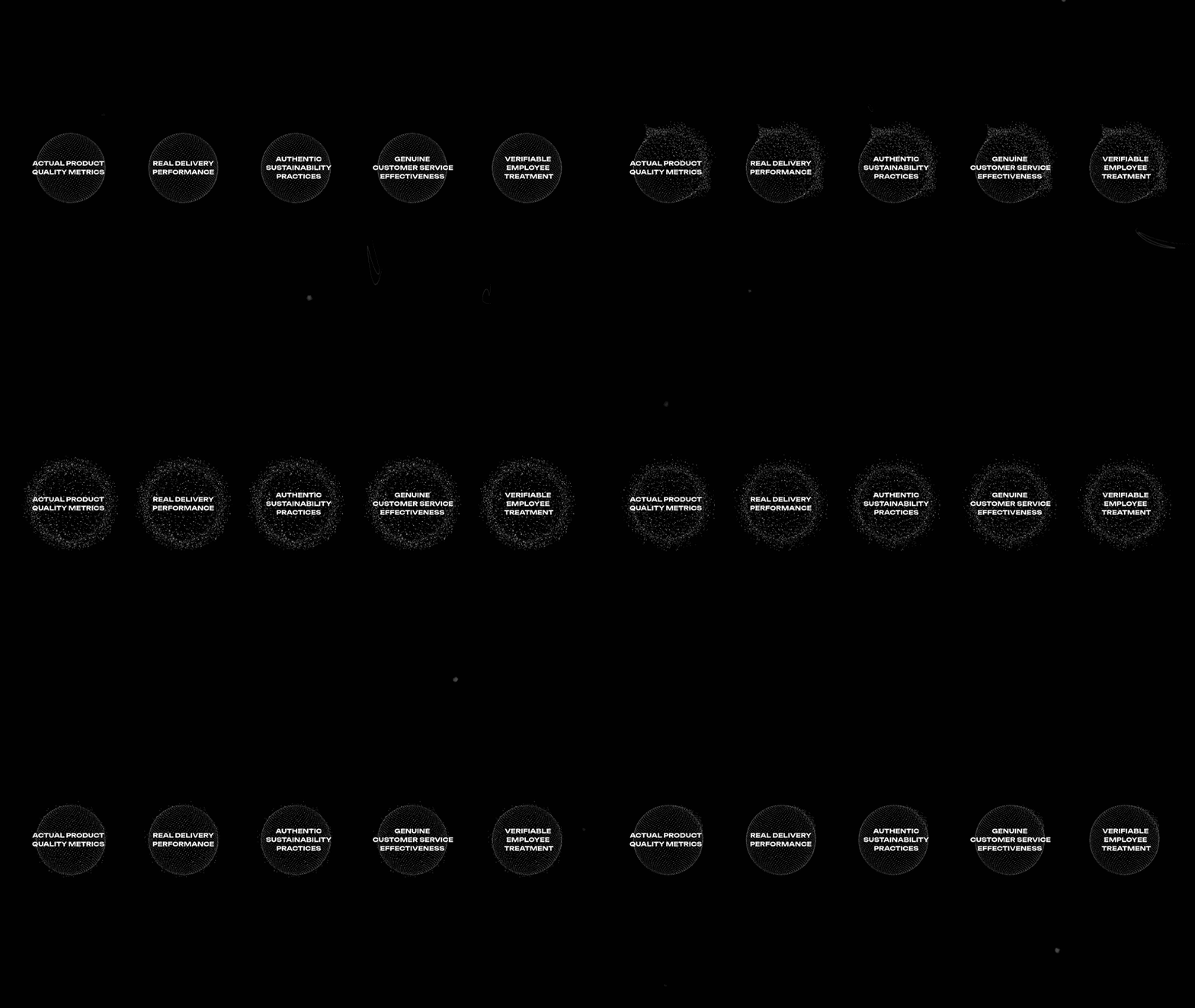
The one with provable quality metrics. Consistent delivery windows. Response times that match what you promised. Supply chains you can defend under scrutiny. Employee treatment you’d be proud to have published.
Because while you’re crafting the perfect brand message, your competitor is showing up in agent recommendations based on their operational reality.
The creative still opens the door. But performance is what keeps you in the room.
But most businesses aren’t structured for this. Which brings us to what needs to change—starting with our own industry.
If operational excellence becomes the primary battleground, where does that leave agencies?
We’ve built an industry on making things look good. On crafting narratives. On creating desire through beautiful work. And we’ve been exceptional at it.
But when an agent can instantly surface the gap between your client’s brand promise and their actual performance—when it can fact-check sustainability claims against supply chain data, or compare stated values against Glassdoor reviews—the old model breaks.
Traditional brand building—the compelling narratives, the beautiful creative, the emotional positioning—becomes one part of a larger equation that must include actual business performance.
And here’s the truth we don’t say out loud enough: we’ve spent decades positioning ourselves as strategic business partners while remaining deeply uncomfortable with the operational messiness of how businesses actually work.
We want the CMO’s ear, but we don’t want to get into the weeds of delivery logistics or employee satisfaction scores.
AI-mediated transparency makes this gap visible. The “lipstick on a pig” model stops working when agents can verify everything.
But this isn’t about doom—it’s about evolution.
The opportunity to move from making businesses look good to making them genuinely better.
So what does this evolution actually require?
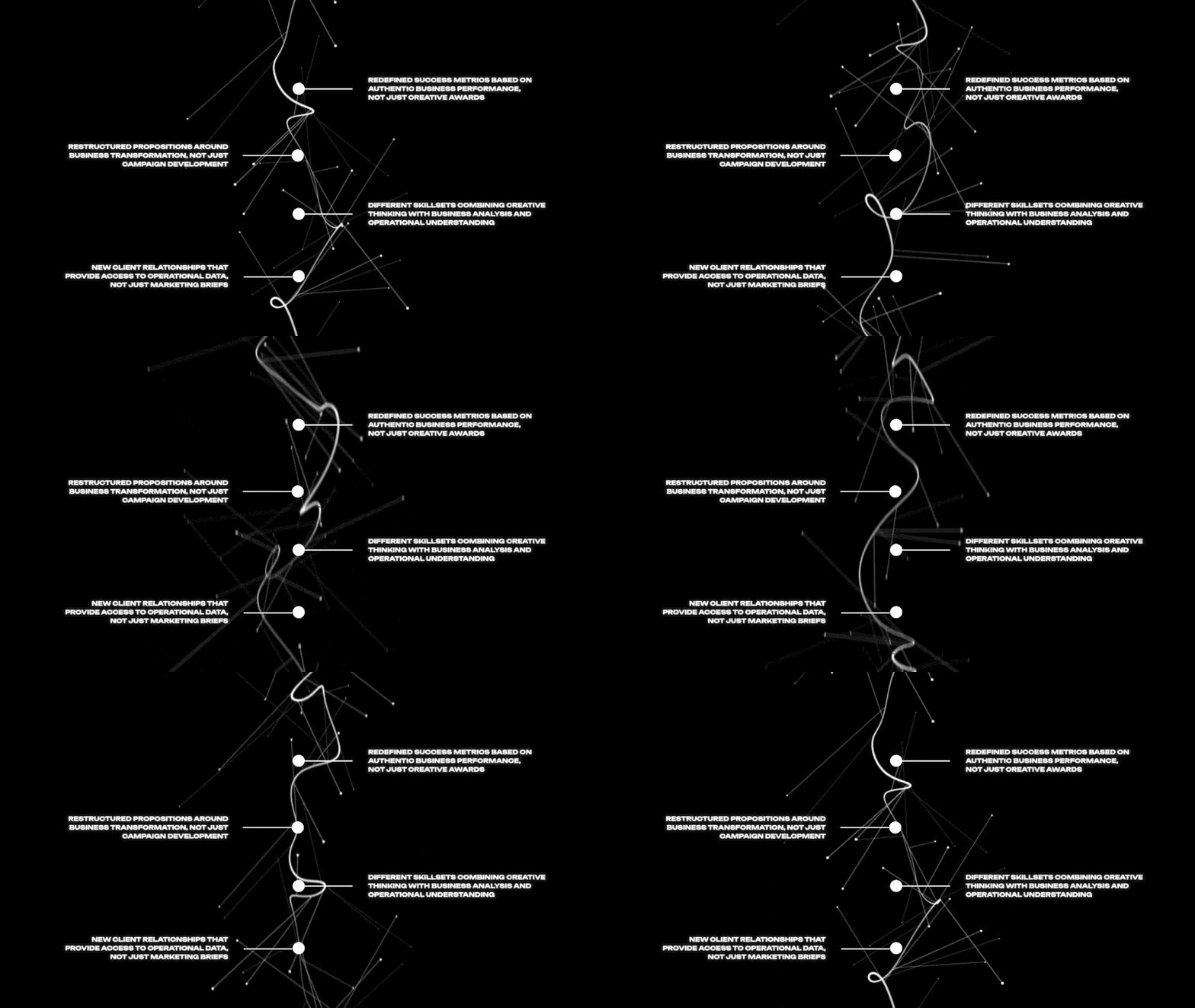
First, new client relationships. You need access to the operational data—not just the marketing brief. You need to see the customer service metrics, the supply chain reality, the employee satisfaction scores. If you’re going to help clients compete in an AI-transparent world, you need to understand the full picture of their business, not just the parts they’re proud of.
Second, different skillsets. Creative brilliance remains essential—but it needs to be paired with people who can read a P&L, analyse operational data, and understand how businesses actually function. The traditional creative-account service model doesn’t cut it anymore.
Third, restructured propositions. You’re not selling campaigns. You’re selling business transformation. That’s a different scope, different pricing, different client relationships. Most agencies aren’t set up for this.
Fourth, redefined success. When your value is measured by business performance rather than creative awards, everything changes—team structure, talent development, what you celebrate internally.
This isn’t incremental adjustment. This is fundamental reinvention.
But here’s what makes it worth it: the agencies that make this leap won’t be fighting for scraps of the marketing budget. They’ll be earning seats at the table where real business decisions get made.
The question is whether you’re willing to become what that actually requires.
This raises three uncomfortable questions for everyone in this room:
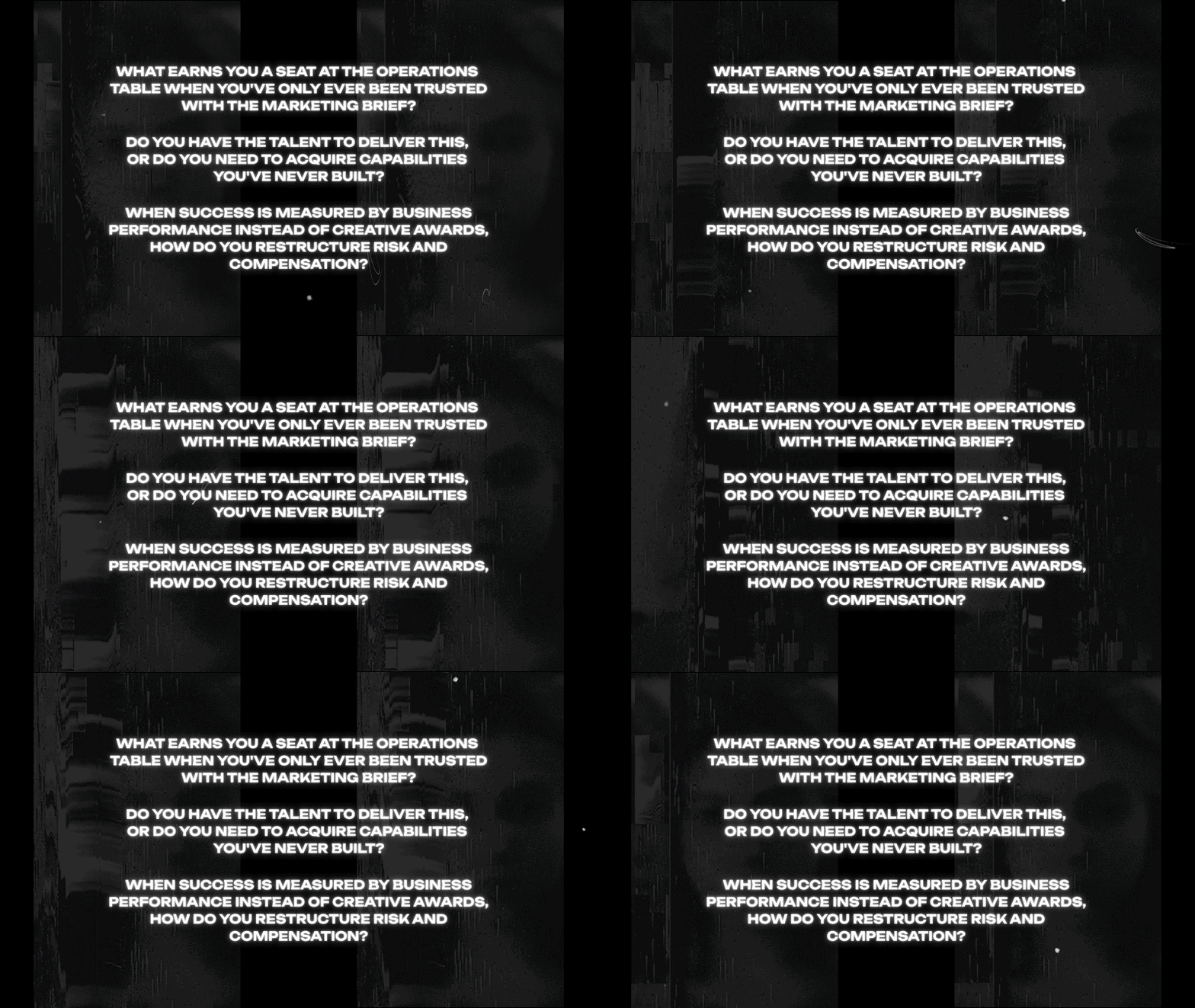
identifying the gap between brand promise and operational reality requires access to data clients have never shared with agencies. Supply chain metrics. Employee satisfaction scores. Real customer service performance. Most of us don’t see that data today. So how do you prove you’re capable of business partnership when you’ve historically been kept at arm’s length?
When the work requires operational analysts, business transformation specialists, and people who understand supply chains and logistics—not just strategists and creatives—where do you find them? Can you hire them? Train them? Or do you need acquisitions and partnerships to build capabilities you’ve spent decades not developing?
Transformation work takes 12-18 months. You’re accountable for operational outcomes, not campaign delivery. Your pricing model, your project timelines, your risk profile—all of it was built for 3-month campaign cycles.
What does your business model look like when you’re being measured on whether the client’s delivery performance actually improved, not whether the creative won an award?
So we’ve talked about interfaces. We’ve talked about data. We’ve talked about transparency and what it means for how we work.
But let’s step back for a moment.
Because underneath all of this—the technical shifts, the business challenges, the industry evolution—something more fundamental is changing.
We started this conversation talking about identity. How marketing has always had a dual relationship with it: building brands that become identity markers, and using identity understanding to target customers.
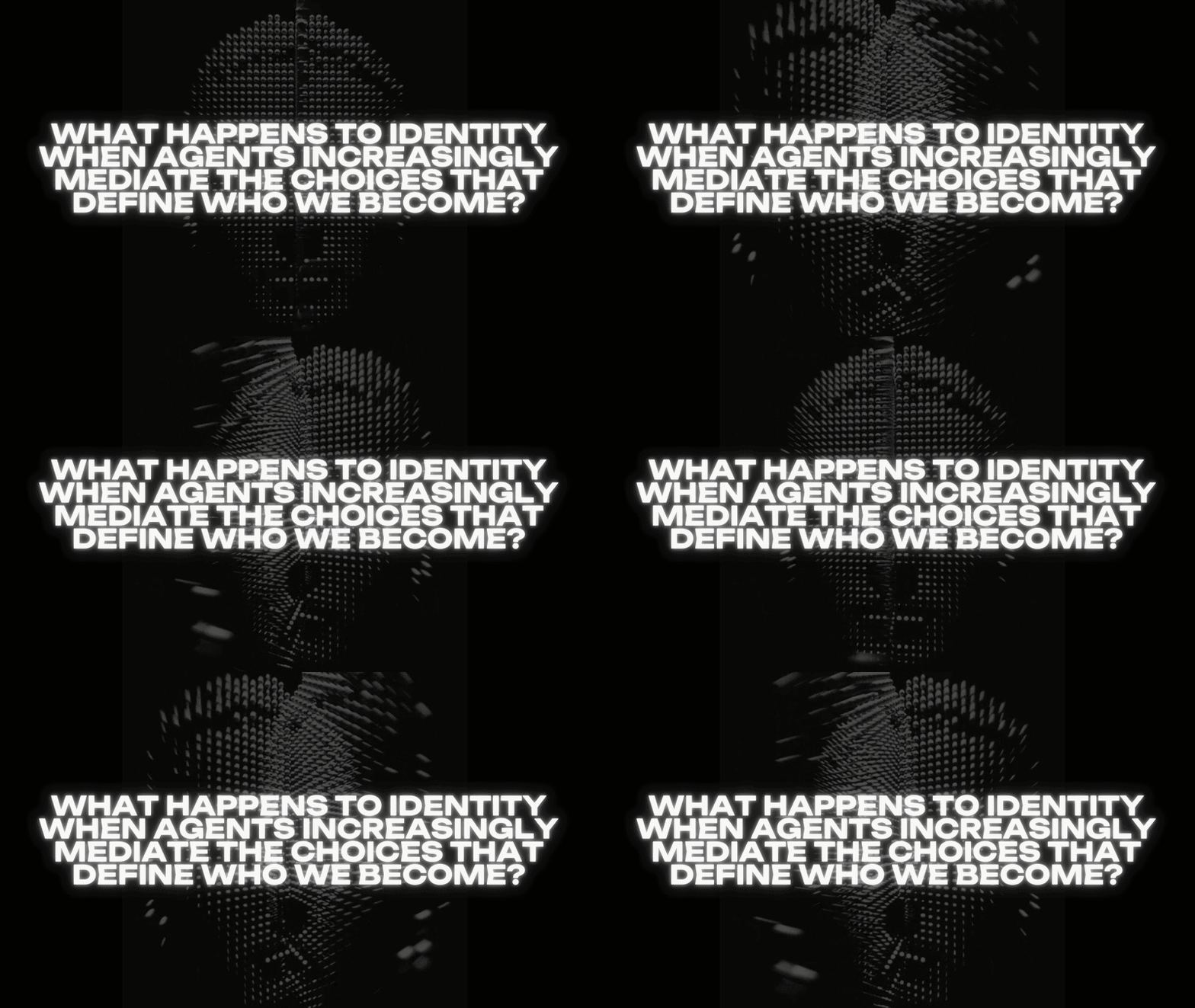
Now let’s talk about what happens to identity itself when AI agents increasingly mediate the choices that define who people become.
Let’s come back to Jenny for a moment.
When her agent selected that belt, it wasn’t just completing a transaction. When it suggested Japanese minimalism, it wasn’t just making a recommendation.
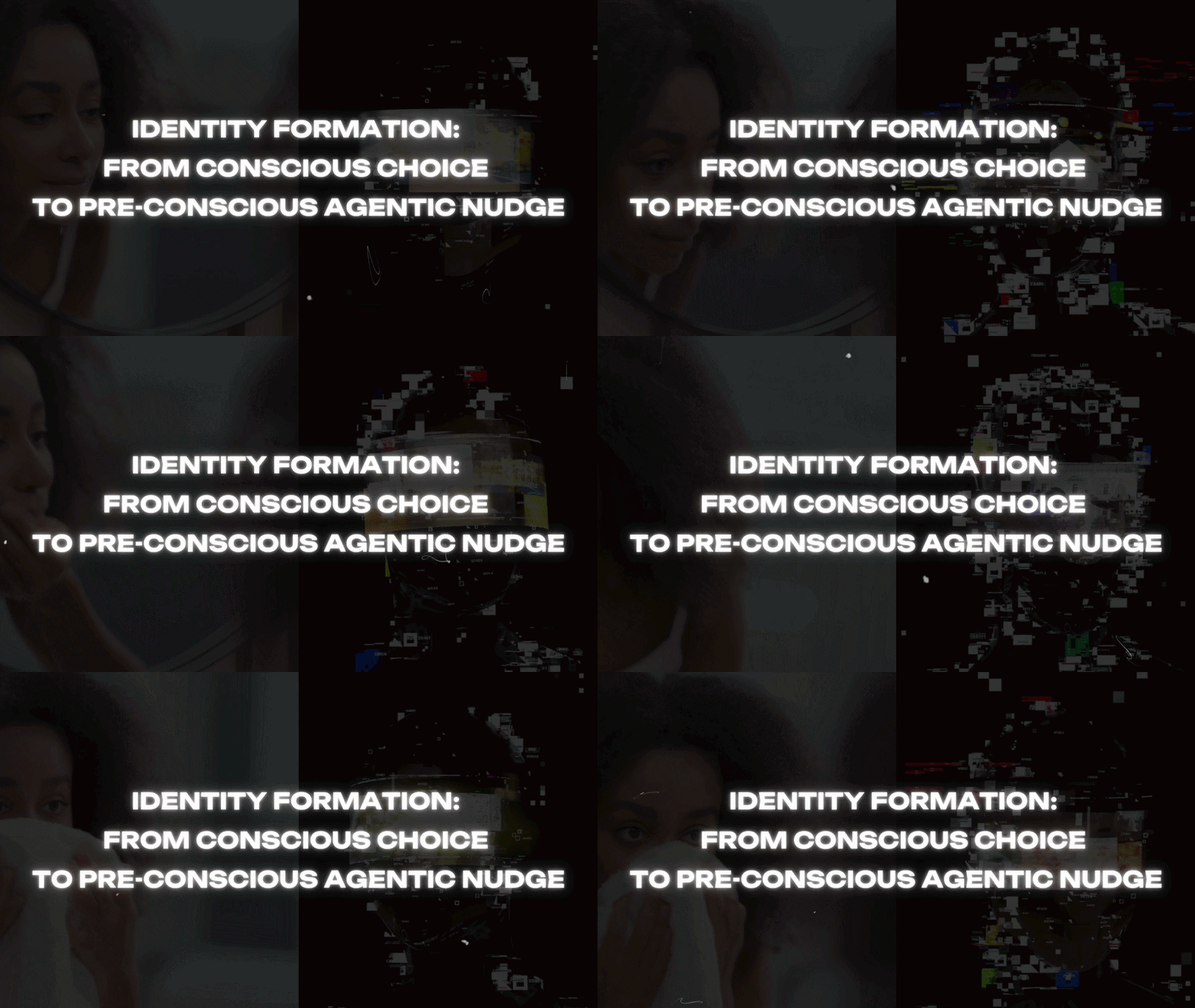
It was shaping who Jenny becomes.
The belt influences how she presents herself. The pottery class creates new social connections. The documentary shifts her values framework.
Each choice—mediated by an AI that detected patterns before she consciously recognized them—nudges her identity in a particular direction.
This is the shift: identity formation moving from something that happens inside us to something that happens between us and AI systems.
Jenny still makes choices. She still has agency. But the menu of options, the context for decisions, the suggestions that feel like they came from nowhere—those are increasingly curated by algorithms optimising for outcomes she never explicitly chose.
This isn’t dystopian. It’s not utopian either.
It’s just what’s happening. Right now. To hundreds of millions of people.
And it has profound implications for anyone in the business of shaping what people want, buy, and become.
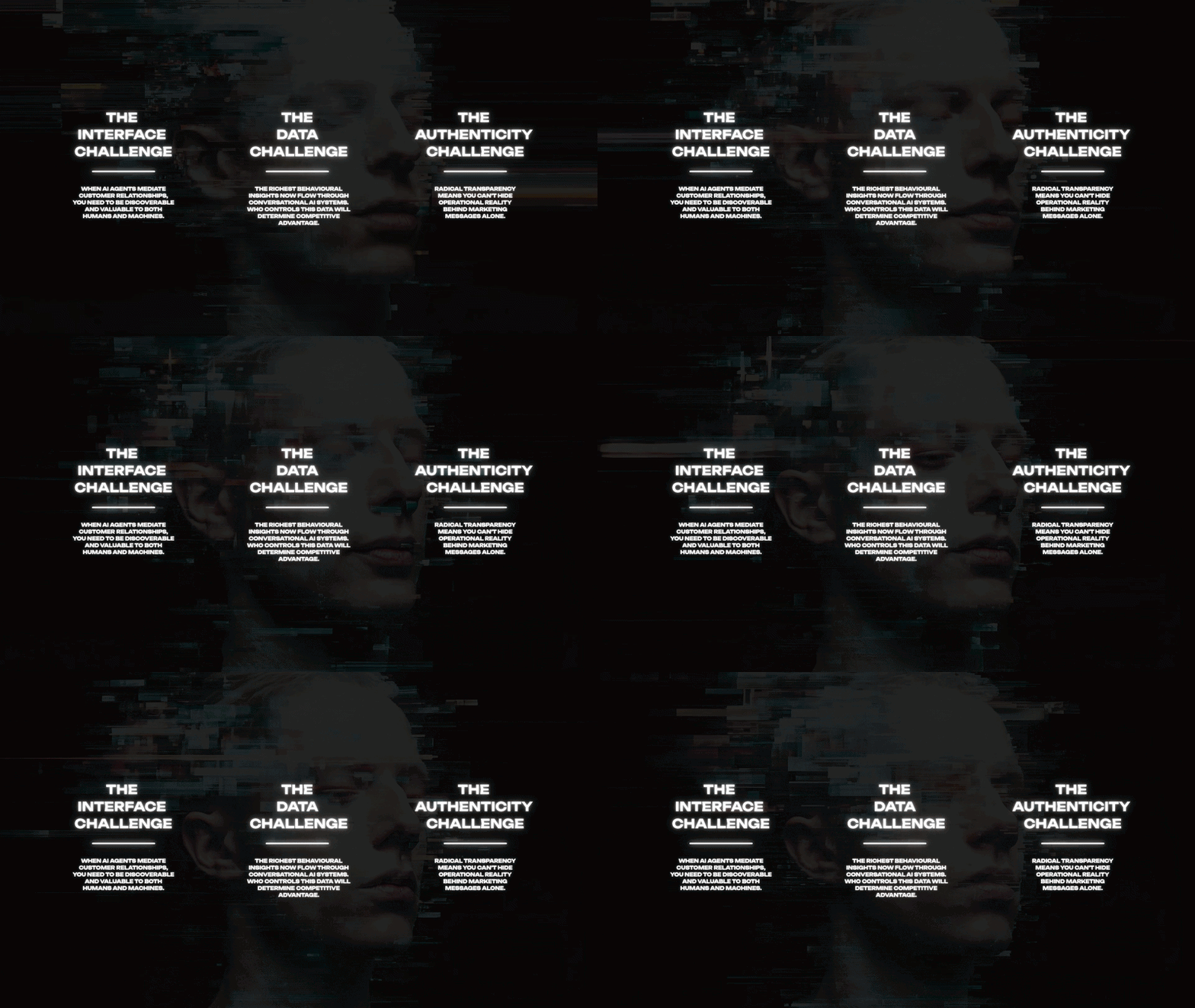
This transformation creates three unavoidable challenges for every business:
The Interface Challenge. You need to be discoverable and compelling to agents while remaining meaningful to humans. That’s dual optimization—machine-readable data ecosystems and emotional brand experiences. Most businesses are built for one or the other, not both.
The Data Challenge. The richest behavioral insights now flow through conversational AI systems. Whether it’s platforms like OpenAI, consumers controlling their own data, or direct relationships—who controls this intelligence will determine competitive advantage. And right now, that control is fragmented and contested.
The Authenticity Challenge. When agents can verify every claim you make, operational excellence becomes the primary differentiator. You can’t hide mediocre performance behind beautiful messaging when the AI is fact-checking you in real-time.
Companies that thrive won’t be those fighting to preserve the old model. They’ll be those that figure out how to navigate all three simultaneously.
Before we get too caught up in the transformation, let’s be clear about what’s not changing.
Human beings will always make sense of themselves through stories, symbols, and emotional connections.
Brand building isn’t dead. The desire for self-expression isn’t going away. People will still choose products that reflect their values and signal who they are.
All of that remains true.
But there’s a new layer now—sitting between intention and choice. AI systems that curate what you see before you decide.
That shape the context in which preferences form. That nudge identity in particular directions based on patterns you’re not aware of.
So the question isn’t “will AI replace marketing?” or “is brand building dead?”
The real question is: How do we build for both?
Because here’s what we can’t do: we can’t just be great at the human stuff and ignore the agents. And we can’t just optimize for algorithms and lose the emotional resonance that makes brands matter.
Everything we’ve built our careers on—awareness, consideration, preference, loyalty—still has power.
But it now operates within a larger, more complex system where AI agents have meaningful influence over what people discover and choose.
The challenge—and the opportunity—is evolving our thinking so we can thrive in both worlds at once.
Not one or the other. Both.

Jenny’s agent made brand decisions in a black box using criteria no traditional marketer fully understands.
It shaped her cultural interests based on patterns she didn’t consciously recognize.
And millions of similar interactions are happening right now, creating customer relationships that brands have limited visibility into.
But let’s be clear about the timeline. This isn’t a distant future.
Three days ago: ChatGPT Atlas launched with browser memories that track everything you do online.
Two weeks ago: Walmart integrated their entire catalog into conversational commerce.
Last month: Shopify brought millions of merchants into ChatGPT’s shopping layer.
Right now: 800 million people are using ChatGPT weekly. It’s the default search for a third of Gen Z.
The transition isn’t coming. It’s underway.
The businesses that succeed will be those willing to engage with these questions seriously, experiment thoughtfully, and evolve continuously as the landscape shifts.
The agents are already making decisions. The question is whether you’re building to be discovered, evaluated, and recommended—or whether you’re building to be bypassed.
And that’s the conversation we need to be having.
Zoe, I think we need to separate the direction of travel from the evidence used to date it. A 300% increase in conversational-commerce queries may be real, but without the absolute base, repeat usage, completed purchases and comparison with ordinary search, it tells us very little about a change in consumer behaviour. I have myself been surprised at the real figures I found: this is yet marginal.
The strongest signals in your piece also come from Meta, OpenAI, Shopify and Perplexity - companies with an obvious commercial interest in presenting the agent as the next universal interface. Their roadmaps matter. They are not yet proof that customers have delegated meaningful choice.
The more revealing number may be Walmart’s: purchases completed inside ChatGPT converted at roughly one third of the rate of those sent to Walmart’s own site. Discovery may be moving faster than delegation. Trust, a recognisable retailer, returns, delivery and recourse still matter when money changes hands.
For brands, the immediate work is therefore less dramatic but more useful. If an agent were asked to recommend us today, could it find, understand and explain the same promise across our product pages, prices, service rules and history? At Le Jardin Retrouvé, our first audit showed that a 50-year-old house with a rich story for humans was largely invisible to simple AI searches. No 2027 forecast is required to fix that problem. We are working on it and are convinced we will achieve the correct lovable (by humans) - legible (by machies) that a brand needs in 2026. How many brands do this sytematically?
https://michelgutsatz.substack.com/p/how-to-make-a-machine-understand