
Creative Mycelium
Part three of the Terra Incognita series.

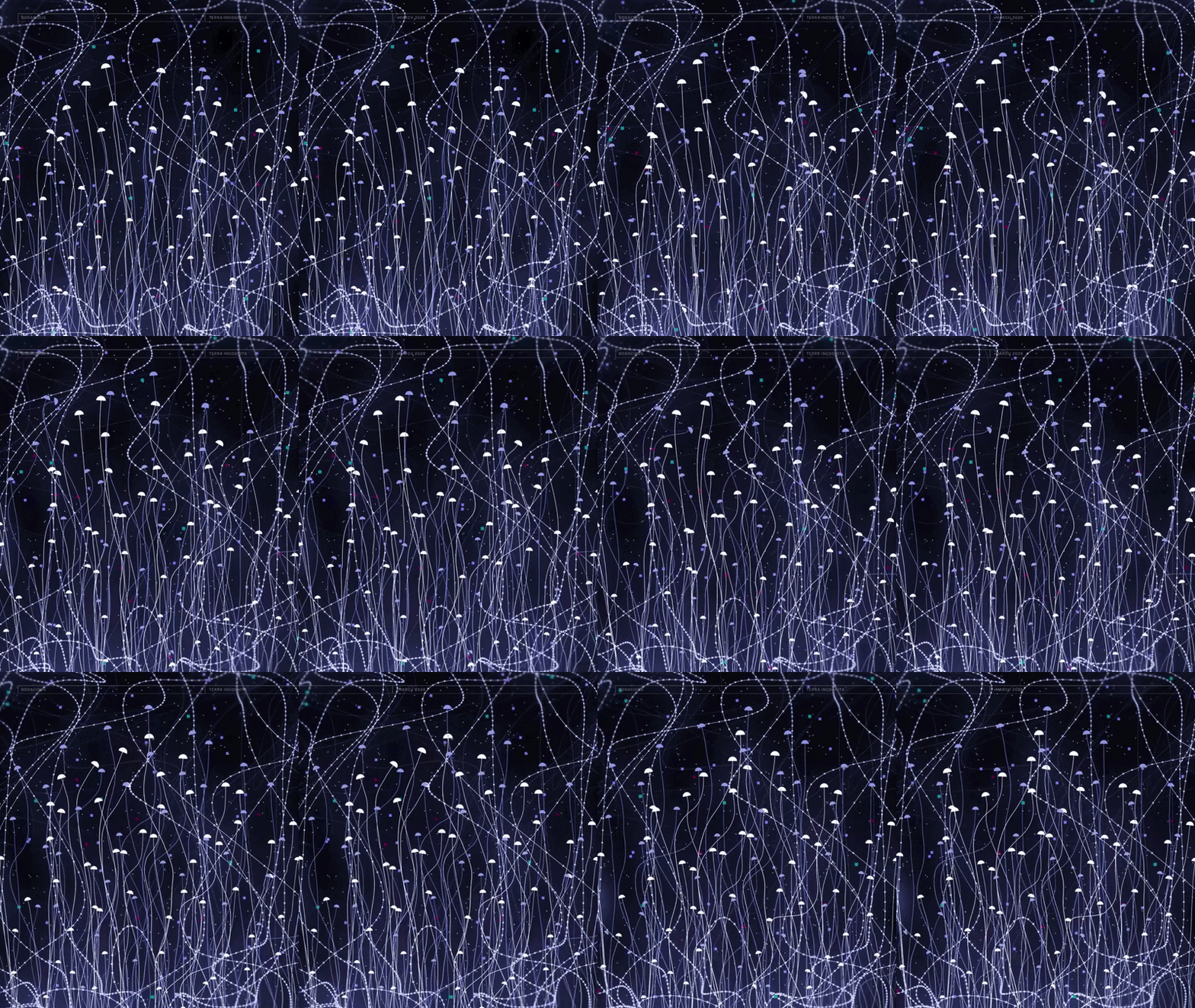
There’s a version of AI that most of us are living inside right now, and it goes like this: me and my model, working alone, in a loop. I generate, it responds. It suggests, I refine. The work gets done faster. The output gets sharper. And at no point in any of this does it occur to me to surface what I’m thinking to the person down the corridor, or the person in the same city on a different floor, or the person three time zones away who has been circling the same problem from a completely different direction.
AI is making us more productive and more isolated simultaneously. And we are, for the most part, calling this progress.
The question nobody is asking loudly enough is what we’re losing in the process. And the answer to that question starts somewhere you might not expect: with the myth we’ve been telling ourselves about creativity for a very long time.
We have invested heavily - decades, centuries if you follow it far enough back - in the idea of the singular creative genius. The lone figure in the studio. The breakthrough that arrived whole. The idea that nobody else could have had. We name things after people. We write biographies about individuals. We build entire award ceremonies around solo authorship. Pablo Picasso gets credited with cubism as though he invented it in an empty room. He didn’t. He and Braque were working in such close dialogue during those years - sharing studios, swapping canvases, finishing each other’s ideas - that for a period they could barely tell their own work apart.
Brian Eno has a word for what we keep erasing: scenius. The intelligence of the scene, not the individual. The ecology that produced the work. The Situationists weren’t Guy Debord in isolation. The Memphis design movement wasn’t Ettore Sottsass alone. The Vienna Secession, the Harlem Renaissance, the Homebrew Computer Club that incubated Silicon Valley - every significant creative movement in history is, on examination, a story about people in proximity, thinking out loud, stealing each other’s half-formed ideas, getting into arguments that dragged the work somewhere neither person would have reached without the friction. Scenius is the intelligence of the whole. And it requires, above everything else, people actually bumping into each other.
Decades before Eno put a name to it, Jane Jacobs was literally building the conditions for it. In The Death and Life of Great American Cities, published in 1961, she argued that what made cities truly vital was collision density - the concentration of people from different walks of life, moving through shared spaces, at sufficient proximity to encounter each other unexpectedly. Short blocks. Streets that forced different kinds of people into the same path. The result was what she called the sidewalk ballet - the daily choreography of overlapping lives and chance encounters that couldn’t be planned or scheduled, but could absolutely be designed for. Cross-pollinated ideas. Spontaneous connection. The creative spark that only happens when people who wouldn’t otherwise meet actually do.
Jacobs was a fierce critic of urban planning that designed out this friction - the straight grid that moves people through without contact, the highway that bypasses the neighbourhood entirely, the building that turns its back on the street. Design for seamlessness and convenience, she argued, and you lose the collisions. Lose the collisions and you lose the energy, the dynamism, the cross-pollination that makes a city worth living in.
Her observations were about urban environments. But the same principle applies at any scale.
Building 20 at MIT proved it. Built fast and cheap after the Second World War - so cheap and temporary that researchers broke walls when they needed more space, rewired it, made it gloriously porous. Physicists ended up next to linguists next to engineers. Disciplines collided because the building didn’t separate them. Nobody scheduled those meetings. The building did it for them. It ran for fifty-five years and produced nine Nobel laureates, the first commercial atomic clock, Chomskyan linguistics and Bose speakers. The output wasn't the product of individual brilliance. It was the product of proximity and collision.
It took the creative industries a few decades to catch up. But by the time the 90s and 2000s arrived, the best agencies had cracked it. Open floors. Ping pong tables. Kitchens placed deliberately in the wrong spot. Sofas that turned corridors into conversations. The whole environment engineered so that brilliant people couldn’t help but ricochet off each other. The strategist who overhears a creative’s frustration from three desks away and realises it connects to the brief she’s been stuck on for a week. The junior who catches a conversation not meant for them and throws in the one idea that makes everything click. The coffee moment where a concept gets bandied around with someone from a completely different team while everyone’s hunting for the oat milk, and somehow, in that thirty seconds, it’s cracked. The best agencies were almost chemical in their creativity - the right people, the right friction, the right conditions, and something happened that nobody could have planned and nobody could quite explain. Collision density as product.
And then it started eroding. From three directions at once.
Remote and hybrid work came first. The honest version - not the glib version that either romanticises the office or dismisses it - is that something real was lost when the corridor disappeared. The collision that used to happen by accident now has to be engineered. And most organisations haven't worked out how.
Then the fragmentation of work into discrete workstreams and walled teams. Even in the same building, people are siloed into their own lanes. The briefing. The brainstorm. The check-in. All formal. All deliberate. The informal, unplanned contact that used to generate the unexpected has been quietly replaced by process.
And then the newest erosion - the AI rabbit hole. Everyone deep in their own individual loop. Getting more productive. Getting more fluent. And getting, incrementally, more disconnected from the people around them. The half-formed question that used to get asked out loud - I’m stuck on this, has anyone dealt with something like this? - now goes to a chatbot. The same technology that was supposed to unlock creative potential is, in its default form, dismantling the sidewalk ballet entirely.
We are getting faster and more isolated simultaneously. And we are calling it progress.
The conditions that made creative collision possible were, on the whole, designed. Cultivating physical proximity and friction to produce the kind of thinking that no individual could reach alone. If it was designed once, it can be designed again. The question is what that looks like now - in a world of distributed teams, hybrid schedules, and everyone deep in their own individual loop.
I found a way of thinking about it in an unlikely place.
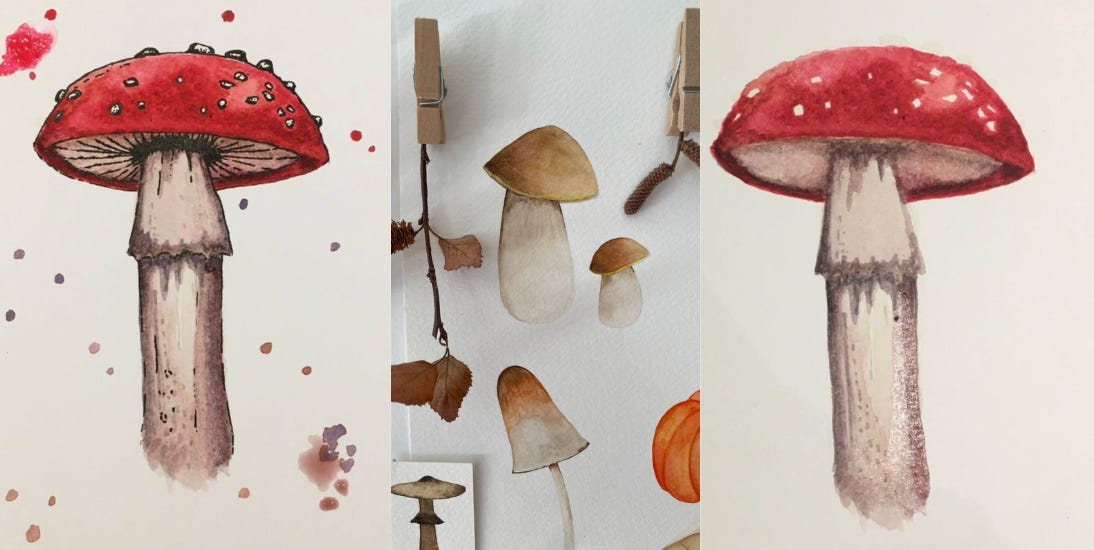
My little sister, Ally, has a thing about mushrooms. She lives in a fairytale cottage on the edge of National Trust woodland, photographs fungi on her walks - enough to warrant a private Instagram dedicated entirely to the subject - paints them, felts them, and has filled every available surface in her kitchen with field guides and monographs. Every Christmas I have to find something mushroom-related she doesn't already own. Mushroom bed socks. A mushroom crocheting kit. A mushroom embroidered jumper. (Etsy has anticipated people like Ally entirely. The range is staggering.)
One afternoon, waiting for the kettle to boil, I picked up one of her books. Merlin Sheldrake’s Entangled Life. As it turns out, mushrooms are not what most of us think they are. The pretty ones, the edible ones, the folklore ones - that’s just the surface. There’s something considerably more strange and significant going on.
Fungi play different roles in the natural world. Some are decomposers - breaking down dead matter, returning nutrients to the soil so that other things can grow. Unglamorous work, but without it nothing else functions. Others form relationships with living plants, exchanging nutrients for sugars in a quiet, continuous trade. Some are predators. Some are parasites. Some fruit visibly, announcing themselves. Most don’t.
But the one that caught my attention was mycelium.
Mycelium is the thread-like root structure of fungi, and what it does is connect. Underneath the soil of a healthy forest, fungal threads weave between the root systems of trees that have no direct contact above ground, carrying nutrients, water, and information between them. Mother trees - the oldest, largest trees in the forest - send carbon through the network to seedlings growing in their shade, giving them what they can’t yet reach themselves. Trees under stress send distress signals. What looks like a collection of separate organisms, each one competing for light, is actually something else entirely. The forest doesn’t just look like a community. It functions as one. And the intelligence running underneath it, invisible from where we’re standing, is mycelium.
A single fungal network can span hundreds of acres, connecting trees that will never be close to each other. The trees can’t move. They can’t bump into each other, can’t have the corridor conversation, can’t stumble across what’s happening on the other side of the forest. And yet the forest has solved the collision density problem anyway. The mycelium does it for them - surfacing, transmitting, connecting across distances that physical closeness could never bridge. And it’s most active not in the pristine, controlled forest, but in the damaged one. When trees are under stress, the connections intensify. The broken ecosystem needs the mycelium more, so the mycelium does more.
I kept thinking about us.
We designed for collision density with proximity. The city, the building, the kitchen. We're losing it, and we need to find ways to rebuild it - but that's a slow, uncertain process and nobody has quite cracked it yet. So what if, in parallel, we built something that extends collision density beyond physical space? Not to replace the hallway conversation, but to make more of them possible - between people who would never otherwise find each other, across distances that proximity alone could never bridge?
AI gets blamed for our creative isolation. Some of that is fair. But AI didn't create the problem - it filled a gap that was already opening, and filled it so well that everyone retreated into it. Every tool built so far has been optimised for the individual. Me and my model. My second brain. My rabbit hole. That's not a law of nature. It's a business model. Personal productivity is easier to sell than collective intelligence. A subscription is simpler than a network. So that's what got built.
But the technology itself doesn’t care. It has no preference for isolation over connection. That’s entirely down to us - to the design choices we make, the questions we ask, the problems we decide are worth solving. Nobody has seriously asked what an AI designed for scenius or collision density would look like. What if we did?
The starting point is rethinking what ambient AI actually means. Right now, ambient means passive - a tool that sits in the background, records what happens, and reports back. A transcription service with a summary attached. Tools like Otter AI are the early prototype of this idea. They sit in your meetings, they capture what was said, they surface action points. Useful, in a limited way. But they’re ears without a brain. They record. They don’t understand. They don’t connect what happened in Tuesday’s meeting to what someone wrote in a Slack thread three weeks ago, or to the strategic tension sitting in a brief on the other side of the building.
What if ambient meant something categorically different? A nervous system - present not just in scheduled calls but across the full texture of how an organisation thinks. The email chains. The documents that never got finished. The conversations that happened and dissolved. Always listening, not to surveil but to understand. To notice patterns and connections and tensions that no individual can see because no individual has the full picture.
I know that the first place people’s minds will go is surveillance. And it's a fair concern - any system that listens across your organisation's communications needs to answer for itself. To me, the difference is intent, architecture, and who the value flows to. Surveillance captures what you think in order to monitor, assess, or control you. A creative nervous system captures what you think in order to connect it to someone else's thinking that you'd want to know about. The output isn't a report to your manager. It's an introduction to a colleague you didn't know you needed. You're not being watched. You're being connected.
And like the mycelium, it should be something you can shape - not just in the sense of privacy settings and opt-outs, but actively. Deciding what you share with the network and what you keep to yourself. Telling it what kinds of connections you're looking for. Directing it toward the problems you're stuck on, the disciplines you want to collide with, the thinking you want to stay close to. The network learns at the level of the whole. But each person shapes their own reach within it - their own nodes, their own roots, their own relationship with the intelligence underneath. The individual is still the tree. The mycelium serves them, not the other way around.
So what does it do in practice?
Designed Serendipity
Two people working on completely different briefs, in different cities, different time zones, maybe different companies - both circling the same underlying tension without knowing it. One is trying to understand why a loyalty programme keeps haemorrhaging members the moment they redeem their first reward. The other is working on why a streaming platform sees its most engaged users disengage sharply after their third month. Both are circling the same underlying question - what happens to desire once it gets what it wanted - but they’d never use the same language for it, and nobody has thought to connect them.
The mycelium notices the shape of both problems, recognises what they share, and makes the connection visible. Not as a solution, but as an introduction. Here is someone working on a problem that rhymes with yours. The collision still has to happen between people. The mycelium just makes sure it does.
The researcher three teams over who already cracked a version of the problem you’re stuck on. The strategist on a different account whose consumer insight maps directly onto your brief. The person in a completely different discipline whose frame of reference would unlock something you’ve been circling for weeks. Without a system that can see across the silos, none of these connections happen. Everyone thinks alone when they could be thinking together.
The Undercurrent
This one lives inside the room. Not just in formal meetings - in the Slack threads that go in circles, the email chains that lose their centre of gravity, the workshops where everyone leaves with a different understanding of what was agreed.
Think about the meeting you’ve been in - and we’ve all been in this meeting - where four people are working through a problem and nobody is quite connecting. Positions are being defended, language is getting sharper, the hour is burning. From inside the conversation, it feels like a disagreement about strategy or direction or priorities. But what if something outside the conversation could see it differently?
Four people all returning, again and again, to the same underlying tension, but calling it different things. They’re arguing about the symptoms. The cause is sitting unnamed in the middle of the room.
The ambient AI has been listening. It’s been mapping not just what’s being said but the shape of what’s being said - the recurring words, the places where energy spikes, the questions that keep getting asked from different angles. And it surfaces what nobody in the room could see from inside it: you’re all circling the same thing. Here’s what it is.
The meeting changes. It’s given the humans the thing they needed to actually start - a shared language for the tension they were already in.
The Undercurrent doesn’t stop at the meeting room door. Point it at a team, a project, an account - and across weeks of Slack threads, email chains, half-finished documents and conversations that dissolved without resolution, it reads the texture of the thinking. The question that keeps resurfacing in different forms. The idea that three people have independently half-formed without knowing it. The rabbit hole everyone keeps falling into. The what-if nobody has said out loud yet but that keeps pulling at the edges of every conversation. When it surfaces that thread - here is where your thinking actually is, here is what you keep coming back to.
The Living Archive
The third function is the one I find most compelling, and it might be the most underrated.
Steven Johnson writes about slow hunches - the insight that arrives incomplete, a fragment of something that needs time and the right collision before it becomes anything. The creative world runs on these. But it also runs on something adjacent and almost never discussed: the killed idea.
The concept that was too strange for this brief. The direction the client couldn’t see yet. The campaign that died in research. The idea someone genuinely believed in and had to let go - because the conditions weren’t quite right. But killed doesn’t mean dead. It often means early. The problem is that those ideas evaporate. They dissolve into the deck nobody opens again, or walk out the door with the person who had them. Two years later the conditions change - new brief, braver client, shifted culture, different moment - and nobody can find the idea because nobody kept it.
The Living Archive holds it. Not stored in a folder nobody opens, but alive - present in the network, connected to what’s happening now, able to recognise when its moment has arrived. The strategic direction explored and shelved eighteen months ago on a different account surfaces when a new brief arrives that it was always waiting for. The campaign that collapsed in research comes back when the culture catches up with it. The thinking that left with a colleague doesn’t entirely leave - their reasoning, their frames, their unfinished questions stay in the network, available to whoever needs them next.
This is what organisations actually lose when people leave, when projects end, when ideas get killed. Not the output - there’s a deck for that. But the thinking. The reasoning that produced the output, the paths not taken, the things that almost worked.
The Edit
By now the obvious objection is forming. More connections, more noise. Another system that surfaces all-of-the-things instead of the right things. Another Slack channel that was supposed to become institutional memory and became another thing nobody reads.
This is where Sheldrake’s observation about the mycelium matters most. It doesn’t transmit everything. It makes decisions - prioritising certain relationships, withholding when withholding serves the network better. It is not neutral. It is a system with discernment.
The Edit works the same way. You set the parameters - what kinds of connections matter, what signal looks like for your team, what you’re trying to find. The system learns from that, gets smarter over time, and starts to develop its own calibration for what’s genuinely worth surfacing. The connections that actually produce something. Everything else, it lets go.
The difference between every failed knowledge system and this isn’t the technology. It’s the judgement. A system that gets smarter and quieter simultaneously.
Imagine working in an organisation where the thinking that happened last year is still alive and findable. Where the person circling the same problem as you - three floors up or three time zones away - gets surfaced before you both spend six weeks arriving at half an answer. Where the meeting that would have burned an hour in circular argument finds its actual question in the first twenty minutes. Where the idea that died too early gets a second life when the world finally catches up with it.
None of the technology required to build this is speculative. Ambient AI exists. Knowledge graphs exist. Recommendation systems that learn from behaviour exist. The components are all there. What doesn’t exist is the intention - the decision to point them at collective intelligence rather than individual productivity. The question of who builds Building 20 for the distributed, fragmented, rabbit-hole world we’re actually in.
Nobody is currently making money from collision density. Every AI company is optimising for the individual because that’s where the money is. Personal productivity. Personal subscription. The incentive structures point in exactly the wrong direction - and left alone, they’ll stay there.
Which means this has to be a design choice. A deliberate decision to build something different. Someone thought about where to put the kitchen in Building 20. The serendipity wasn’t accidental - it was engineered, just lightly enough that it didn’t feel like engineering. The same intent needs to go into building the AI layer underneath creative work. Not purely as a productivity tool. But as a network.
There are two honest tensions worth naming before we get there.
The first is the echo chamber risk. A network that learns to surface similar thinking might produce clustering rather than collision - connecting the ideas that are already adjacent, reinforcing what people already believe, missing the productive friction that comes from the genuinely different. The standard has to be unexpected connection, not comfortable adjacency. If the mycelium only finds what you’d have found anyway, it’s not increasing collision density. It’s just adding a layer of confirmation.
The second is simpler: you cannot design your way to the hallway conversation. Some collisions need bodies. The energy in the room, the whiteboard, the person who catches something in your face before you’ve said it out loud. The mycelium doesn’t replace any of that. It extends the reach of it - across distance, across discipline, across the gaps between people who will never occupy the same building. The goal was never to replace physical proximity. It was to stop pretending that physical proximity is the only way connection happens.
And the world we're building it for couldn't be more ready for it.
Distributed. Fragmented. The collision density that produced cubism and Building 20 and every scene worth belonging to is harder to sustain than it has ever been.
But the mycelium doesn’t wait for ideal conditions. It’s most active where things are broken. It threads connection through the damaged places, the gaps, the margins where nothing looks like it should be able to grow.
That's not a metaphor. That's a blueprint.
Zoe, this is one of your best articles! A prompt for the "HI" human intelligence sitting on every pair of shoulders! I sense a spiritual current in this!
Love this, Zoe, applying the mycelium mushroomprint to the next AI gen, so we don't lose our humanity and creativity. Again, staying closer to nature will save us!