
Forking Futures
Part two of the Terra Incognita series.

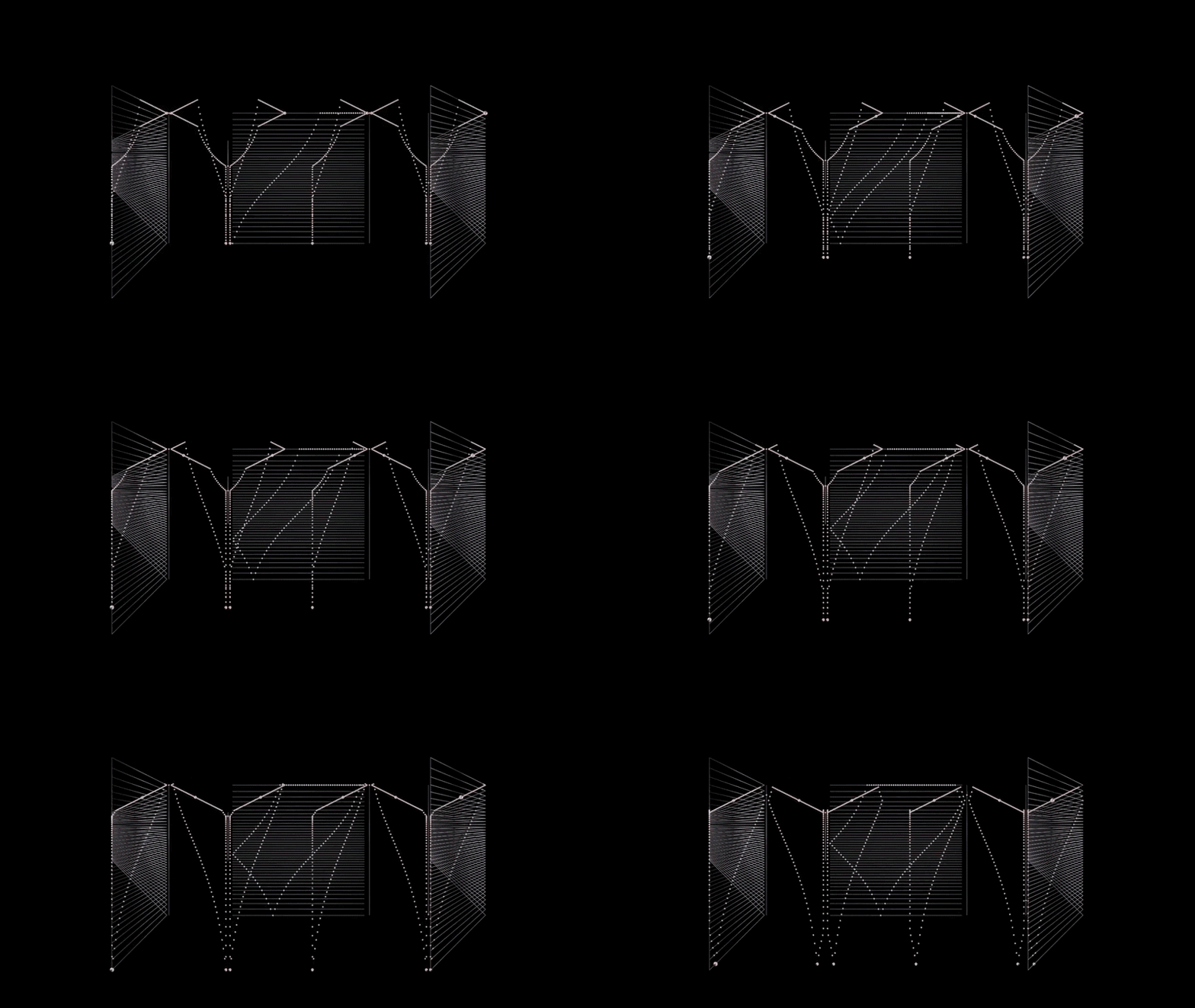
In Part One of this series, I explored what happens when a brand stops being a document and becomes something that thinks - a system that holds the logic, the judgment, the accumulated intelligence of how an organisation navigates the world. If you haven’t read it, start there. It sets up what follows.
Terra Incognita is about the coordinates beyond the efficiency play. The new forms of creative and strategic practice that emerge when you stop treating AI as a production tool and start treating it as something to think with. Each piece takes a different coordinate. Part One was about thinking. This one is about futures. Plural.
Here is a fact about every strategy your organisation has ever produced: it was a bet on a single future.
One set of assumptions about what’s coming. One recommended direction. Two or three alternatives that exist mostly to make the recommendation look considered. A singular path forward, chosen through analysis and debate and political negotiation, then committed to. Resources allocated. Roadmap built. Execution underway.
And then everyone finds out - months or years later - whether the future they planned for was the future that arrived.
It almost never is.
This has always been the deal with strategy. You analyse, you choose, you commit. The quality of the bet depends on the quality of the thinking, the rigour of the analysis, the experience of the people in the room. But it’s a bet. On one future. The cost of being wrong isn’t both financial and temporal. You can’t get the time back. And in a world that shifts faster than your planning cycles, the future you prepared for is almost always a different shape from the one that shows up.
But something’s changed. The world used to move in roughly one direction at a time. A recession hit and you planned for a recession. A new competitor emerged and you responded to the new competitor. Sequential disruptions, navigated sequentially.
That is not the world we’re in.
Climate policy, platform shifts, regulatory fragmentation, supply chain reconfiguration, cultural realignment, geopolitical fracture - these aren’t happening one after another. They’re happening simultaneously. Overlapping. Interacting in ways nobody fully maps. A tariff decision reshapes a supply chain which shifts a competitive landscape which changes a brand’s positioning which alters how a cultural audience relates to it. Pull one thread and the whole web moves.
And the mechanism for navigating all of this? Pick a lane. Build a deck. Hope for the best.
Two layers of failure here. Both worth naming.
The first: scenario planning, as most organisations practise it, is a decision-laundering exercise.
Three scenarios get built. Everyone in the room already knows which one will be chosen before the exercise starts. It’s always the middle one. The optimistic scenario exists to make leadership feel ambitious. The pessimistic one exists to make the moderate path look responsible. The whole exercise exists to retroactively justify a decision that’s already been made. It gives the appearance of rigorous strategic exploration while doing precisely none of it. The real function isn’t to open up possibilities. It’s to close them down in a way that looks considered.
People know this, by the way. Everyone who’s sat through one of those sessions knows. The strategist presenting knows. The CMO nodding along knows. The agency partner who built the deck knows. Nobody says it because saying it would break the ritual. And the ritual is what makes the decision feel safe.
Scenario planning, as commonly practised, isn’t a tool for navigating uncertainty. It’s a tool for making certainty feel earned.
The second layer: even when scenario planning is done seriously - genuine intellectual rigour, honest assumptions, real investment of time - it produces three worlds built at a point in time, then left to gather dust. Never revisited. Never allowed to interact with each other. And the variables that actually determine strategic outcomes don’t behave independently. They cascade. They interact. They compound. We’re planning for interlocking systems with three slides and a traffic light system.
A brief sci-fi interlude, because I can't help myself: the problem we're describing - how to navigate futures you can't predict - isn't new. Someone imagined a solution to it in the 1940s.
Isaac Asimov’s Foundation gave us psychohistory - the idea that if you could model the behaviour of large populations mathematically, you could predict the trajectory of civilisations.
The story centres on a mathematician named Hari Seldon who can see the fall of a galactic empire before anyone else does. He can’t stop the collapse. But he can build institutions that shorten the dark age that follows. Thirty thousand years of chaos compressed to a single millennium, because one person could model what was coming and steer toward a less catastrophic version of the inevitable.
It was fiction, of course. But the interesting part isn’t whether psychohistory is possible. There’s a decent argument it isn’t - Asimov himself built the Mule into the story, a character who breaks the model precisely because he’s the variable psychohistory couldn’t encode. The interesting part is that the ambition behind it - modelling complex systems to navigate between possible futures - is now being enacted at scale.
Not by mathematicians, but by engineers. In silicon.
Digital twins.
BMW doesn’t wait to see if a new car model fits on its assembly line. It builds the entire factory as a digital twin first - every robot, every worker, every logistics flow - and runs the simulation before a single physical change is made. Thirty global production sites, each with a virtual counterpart. What used to take four weeks of physical testing now takes three days in simulation. They’re virtually preparing over forty new vehicle models before 2027. The factory exists twice - once in atoms, once in data - and the data version gets tested first.
NVIDIA’s Earth-2 is a digital twin of the planet’s climate system. A full simulation of atmospheric behaviour at kilometre-scale resolution, running a thousand times faster than traditional numerical models. The stated ambition: simulate future climate states so that cities, governments, and industries can test decisions - about infrastructure, about policy, about investment - before they commit to them in the physical world. Run forward. See what happens. Decide accordingly.
Singapore built a digital twin of the entire country. Every building, every road, every underground utility, every green space - captured in a 3D model fed with real-time data from thousands of sensors. Urban planners test new developments, simulate flood scenarios, model crowd dispersal, optimise transport flows - all before anything is built or changed in the physical city. The world’s first digital twin of a nation. Completed in 2022. Already evolving into a subsurface twin that maps everything underground.
The NHS has piloted digital twin models to simulate how new health policies and pandemic measures would impact hospitals before implementation. In cardiology, personalised digital heart twins now simulate individual patient responses to different treatments - running the fork between treatment options in a virtual body before touching the real one. The FDA issued guidance in 2025 encouraging the use of digital twin simulations in medical device regulatory submissions. And if the regulatory apparatus is catching up to the technology, that tells you the technology is no longer speculative.
What’s happening here isn’t “we’re making simulations.” That undersells it. Every complex system that matters - factories, cities, climate, healthcare, supply chains - is being given a virtual counterpart. A shadow that can be tested, stressed, forked into different scenarios, and run forward in time.
The physical world is growing a twin. And the twin is where the decisions are increasingly being made.
Most of what passes for strategic simulation is defensive. You take your existing strategy - the one you’ve already chosen - and put it under stress. Does our plan hold up if the market drops fifteen percent? What happens to our supply chain if this supplier goes offline? Can our campaign survive if the platform changes its algorithm?
And even this is rare. Most organisations aren’t stress-testing their strategies at all. They’re just committing and hoping. The deck gets approved, resources get allocated, and the next serious interrogation of the direction happens when something goes wrong.
But even the organisations that do stress-test are doing something very conservative. They’ve already decided what they’re doing. They’re checking whether the decision holds up when conditions deteriorate. Testing resilience. But not exploring possibility.
And it gets substantially more interesting when you move past the stuff that behaves according to physics and into the dynamics that actually determine whether an organisation thrives or dies. Interacting forces that compound and cascade. That’s what makes them unplannable with static tools. And that’s where forking futures gets genuinely new.
So what does it look like when strategy can fork?
“We’re weighing whether to enter a new market. Fork it: one thread where we go in, one where we don’t. But not to decide yes or no. To see what each path surfaces that the other misses. The entry fork reveals dependencies in our supply chain we hadn’t mapped. The hold-back fork reveals how much our existing market is already shifting beneath us. The interesting output isn’t a recommendation. It’s a map of what we didn’t know we didn’t know.”
“Regulation is coming for our category but nobody knows what shape it takes. Fork three versions - light touch, heavy intervention, fragmented by market. Not to stress-test our current plan against each, but to see what business we’d need to become under each one. The light-touch fork might reveal we’ve been over-investing in compliance frameworks we don’t need. The heavy-intervention fork might surface a product opportunity nobody’s pursuing because everyone assumes the regulation won’t go that far. The fragmented fork might show us that the complexity itself is a moat - if we’re the ones who can navigate it.”
“Our biggest competitor just made a move we didn’t anticipate. Don’t fork responses. Fork interpretations. One thread where it’s a sign of strength - they’re expanding because they can. One where it’s a sign of desperation - they’re diversifying because their core is weakening. One where it’s misdirection - the real move is somewhere else entirely. Each interpretation generates a completely different strategic landscape. The question isn’t ‘how do we respond?’ It’s ‘what world are we actually in?’”
These are the beginning of a conversation, not the end of one. You interrogate the forks. Challenge them. Ask what they’re missing. Push them further. Combine elements from one thread with elements of another. Kill the ones that stop making sense. Resurrect one you’d dismissed when new information arrives. The thinking develops through the exchange - the same way the best strategic thinking always has, except now you’re not limited to the futures your team can hold in their heads simultaneously.
You look for convergence - the moves that hold regardless of which future arrives. These are your high-conviction bets. And you look for divergence - the places where outcomes depend entirely on which future materialises. These are where you need flexibility, or the honesty to say “we don’t know yet, and we’re going to wait for more signal before we commit.
It’s all about navigable possibility spaces.
That’s the mechanism. But as with Part One, the mechanism isn’t the interesting part. The interesting part is what it does to the people who use it.
You move from strategist-as-gambler to strategist-as-navigator. From placing a single bet to holding multiple futures in tension, developing judgment about when to converge - when to stop forking and commit. Less “make the best call with the information you have.” More “read the branching paths and know when to step off one and onto another.” That’s a very different skill. It barely exists as a discipline right now. It will.
You become someone who can show the organisation not just what you recommend, but what you considered and why you killed it. The reasoning becomes visible. The ghosts of abandoned strategies are preserved - accessible, documented, with the logic of their abandonment intact. And sometimes, when the world shifts, you bring one of those ghosts back. Because the future that made it wrong last quarter is no longer the future that’s arriving.
This connects directly back to Part One. A brand that thinks holds the accumulated intelligence of how it navigates the world. Forking futures adds a dimension - the brand doesn’t just remember its past, but can simulate its possible futures. Intelligence that compounds in both directions. Backwards, into institutional memory. Forwards, into strategic possibility.
And the organisation develops a different relationship with uncertainty entirely. Not “we don’t know, so let’s hedge.” Not “we don’t know, so let’s wait.” Something closer to “we don’t know, so let’s run it and see.” Active uncertainty. Productive not-knowing.
The difference between standing at a crossroads trying to guess which road is right and being able to walk a hundred metres down each one before deciding.
Like Asimov’s Foundation - but inverted. Psychohistory assumed you could predict one future and engineer toward it. A single plan, unfolding across centuries. This assumes you can’t predict any future with certainty, but you can hold multiple futures simultaneously, compare them, and develop the judgment to navigate between them.
None of this is without cost, so here are four tensions worth being honest about.
The simulation trap. Running models creates an illusion of having “seen” the future. You haven’t. You’ve mapped possibility spaces based on your own assumptions, your own data, your own blind spots. The future that actually arrives is usually the one you couldn’t imagine - the variable the model didn’t encode. Asimov knew this. He built it into the story. The Mule breaks psychohistory because he’s a discontinuity the model couldn’t contain. Every simulation carries the fingerprints of whoever built it. Humility about that matters enormously. This won’t make you Nostradamus.
The modelling gap. This one deserves the most honesty. Physical systems - factories, climate, infrastructure - behave according to physical laws. We can model them with increasing precision because the underlying logic is consistent. Strategic and cultural systems don’t work that way. Human behaviour, market sentiment, political dynamics - these are messier, more reflexive, more prone to sudden phase transitions that no model anticipates. A meme changes the political landscape overnight. A scandal reshapes an entire market’s relationship with a brand category. A cultural mood shifts and suddenly the positioning that felt right for three years reads as tone-deaf. Modelling these dynamics is valuable. But the confidence we bring to physics-based simulation hasn’t been earned in the strategic domain. The danger is in importing that confidence anyway.
Power. Who controls the forks? Who decides which futures get explored and which don’t? The assumptions baked into starting conditions shape everything downstream. If only one team can run the simulations, they’re defining the organisation’s horizon of the possible. The same dynamics from Part One - who holds the knowledge, who defines the territory - show up here in different form. Encoding how a brand thinks is political. Defining which futures it explores is even more political.
The seduction of optionality. Keeping all doors open feels safe. It isn’t. Optionality without commitment is just drift. You can fork endlessly, study every branching path, maintain perfect flexibility - and arrive nowhere. The organisations that will do this well are the ones that also prune ruthlessly. Run twelve futures. Get to three. Then one. Know when you’ve seen enough, when the signal is strong enough, when the cost of not deciding exceeds the cost of deciding wrong.
Asimov imagined this as the province of a lone genius mathematician working in secret. It won’t be that. It’ll be a practice. A discipline. A new muscle that organisations either develop or don’t.
The ones that do develop it won't predict the future. They'll just be ready for more versions of it. And right now, that's the closest thing to an advantage there is.
Beautifully written, but you actually outline how foresight professionals have been working... or at least tried to work for decades. I think you'll have a hard time finding a futurist who claims to 'predict the future' or who will say the future isn't plural. The real struggle is what you also point to; the power and politics dynamic and when foresight becomes just another exercise during strategy season, rather than a real exploration of possibilities. I have so many times dealt with clients who hired us to confirm their assumptions about the future and got frustrated when we didn't. Anyway, I don't know if you read how they originally used Scenario Planning at Shell in the 70s. In fact I you haven't read it, I'd highly recommend Pierre Wack's article about how they developed scenario planning, in Harvard Business Review from 1985. It's called 'Uncharted Waters Ahead', and that is not the only echo over time to resonate with your current piece. https://hbr.org/1985/09/scenarios-uncharted-waters-ahead
Anyway, as always... thank you for writing so clear and succinct. Inspiring as always.
So excited for the third in the series.
This feels like the middle ground I’ve been looking for off the doomsday vs same same mindset that everyone is arguing about (reminds me of the nature / nurture debate, or the “brand vs performance marketing- the answer is both / the middle).
A post I read yesterday talked about the dot com boom, and all it did was make people work in slightly different ways, and what you’re talking about is strategy / insight / foresight evolution inside an organisation. Not revolution. Not staying the same. Structural change that we’ll look back on in 10 years and say “can you believe that’s how we used to work!?”
But who are the people / companies doing the digital twin work!??! I wanna work with them!!!