
Heartwood

Athens, last Friday. The House of Beautiful Business World Forum.
A fictional board meeting playing out on stage. A thousand people watching. I stepped out into the middle of it to deliver this.
The most condensed version I’ve managed of an argument that’s been pulling at me for months. About what happens to institutions when every one of them is running on the same intelligence. About the one thing that distinguishes them - an asset most organisations are cutting away without even noticing it.
I used that stage to name it.
I want to start with a number.
Ask any AI model - ChatGPT, Claude, Gemini, take your pick - for a random number between 1 and 10. It’ll say 7. Almost every single time.
Springboards ran the experiment across every major model, a hundred trials each. GPT landed on 7 ninety-two times out of a hundred. Claude, ninety. Gemini said seven a hundred times in a hundred.
Humans pick 7 too. About 28% of the time - three times what you’d expect from chance. And we do it for a reason that’s worth pausing on. We’re not picking a random number when we’re asked to. We’re performing what we think a random number sounds like. The ends feel too obvious, the even numbers too orderly, the middle too predictable. Seven sits in this strange sweet spot of feeling spontaneous and slightly off-centre.
We’re not being random. We’re doing an impression of randomness.
And AI watched us do it, learned from us, and now does the same thing - at scale, with total confidence. From 28% to near-certainty. Because when a model is trained on the most popular answer, the most popular answer eventually becomes the only answer worth giving.
That’s not a fun fact about random numbers. That’s a portrait of what’s happening to thinking right now.
The intelligence everyone is now using is the same intelligence. From a small number of models. Trained on overlapping data. Optimised against similar benchmarks. Your data sits on top of theirs. The interface looks bespoke. But underneath the customisation, every one of these systems is reasoning from the same ground.
This is not a diversity of minds. It’s one mind, and a thousand faces, running inside a thousand companies who all believe they’re getting something distinctive.
We have built the most powerful consensus engine in human history. And we’re calling it our edge.
One of the men who benefits most from that consensus told us - at the BlackRock Infrastructure Summit two years ago - exactly what he’s selling.
Intelligence, Sam Altman said, is becoming a utility. People will buy it like electricity, like water. One day it’ll be too cheap to meter.
He’s selling abundance. Investors love it. So do boards.
But here’s the strange thing about abundance from a single source. The more abundant something becomes, the less valuable any one buyer’s access to it can be. Nobody competes on water. Nobody differentiates on electricity. Commodities are the floor - never the ceiling.
Altman is accidentally describing the devaluation of the very thing he’s selling. The same intelligence, flooding everything. Every organisation drinking from the same well, getting back the same answers, all arriving at 7.
Which is why I’d argue the strategic question of the next decade isn’t the one most boardrooms are asking.
It isn’t how do we use AI?
It’s: what happens to an institution that adopts a technology designed to make every institution it touches look like every other institution it touches?
What can possibly distinguish your organisation from your competitor’s, when both of you are running the same reasoning engine?
Your data alone won’t hold - it’s a leg up, not a moat. Your tech won’t hold - your competitor has the same vendor list. Your people won’t hold - in the long run, they all move on.
The only thing that distinguishes one organisation from another, in a world of identical intelligence, is what your organisation knows that the model cannot. Not what’s written in the documentation. The things that aren’t in any document.
The institutional memory of how this place behaved through the last crisis - and how it shapes the way every difficult call gets handled today. The shared sense, in a long-tenured leadership team, that a particular brief feels off before anyone in the room can articulate why. The decision rules that emerged from failures nobody even remembers anymore, but that everyone quietly inherited. None of it was ever written down - not because anyone was careless, because it lives in the doing.
This has a name. Heartwood.
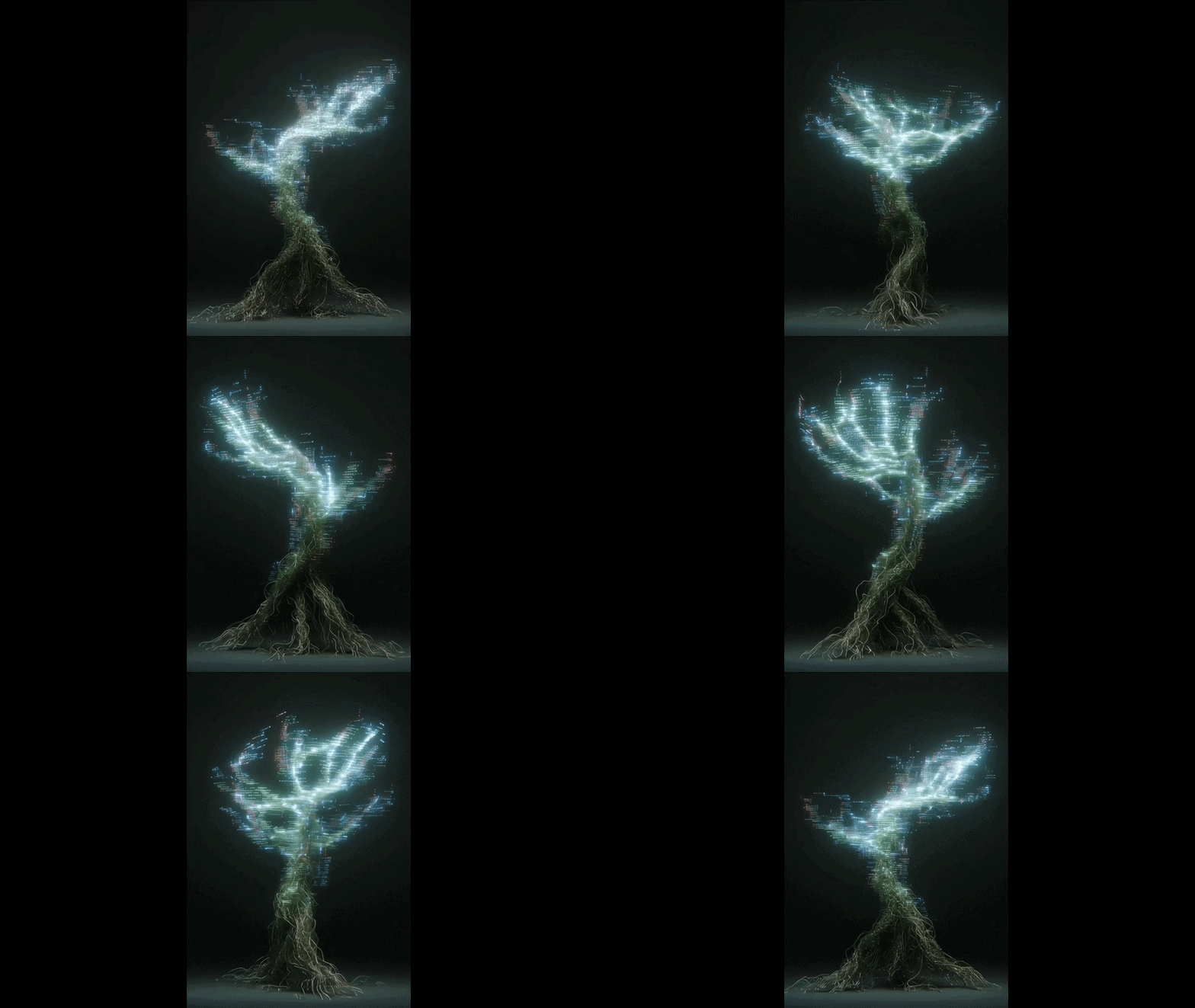
Heartwood is the dense inner wood of a tree. It forms slowly, over decades. You can’t see it from outside. And once it’s cut out, you can’t grow it back on any useful timescale.
In an institution, heartwood is the accumulated judgment, relational memory, ethical stance and tacit knowledge that distinguishes one organisation from another. It’s what the organisation is made of - not what it does.
And we are about to lose it.
We have started to worship intelligence as if it were judgment. Compute as if it were truth. Model output as if it were expertise. Once you accept that - even half-consciously - there’s no part of an organisation you don’t deploy AI into. Speed wins every comparison with wisdom, because wisdom looks slower, less articulate, less confident than the model. Margin gains follow. Productivity climbs.
Right now, in nearly every major organisation, the heartwood is being cut.
It’s happening at a pace nothing has prepared us for. Heartwood is the slowest thing an organisation builds. AI is the fastest thing an organisation has ever deployed. The slowest asset, meeting the fastest rollout - which means the cut is happening faster than any institution can notice it’s happening, let alone stop it.
I’m watching it happen from the inside. The strategy work I do puts me in the rooms where these conversations are happening, and where the decisions are being made. Banks, retailers, consumer giants, foundations. And in every one of them, the same set of substitutions is unfolding. Productivity becomes the proxy for purpose. Margin for the long view. The institution measures only what AI improves, and stops measuring what AI removes. By the time the loss shows up in any dashboard, the heartwood is gone.
But this isn’t an inevitability. It’s a choice.
Rather than letting AI cut your heartwood, you could use it to wield that asset differently. To hone it. To strengthen it. To make the way your institution thinks the substrate the intelligence runs on - not the consensus substrate everyone else is running on.
Because heartwood is what opens up the full range of what’s possible with AI. Not just how to use the off-the-shelf model - but what to build, what to commission, what to configure, what to refuse. Where AI belongs and where it doesn’t. What kind of question this is - and whether it’s even an AI-shaped question at all. What the model’s output means in this specific context, with this specific history, for this specific institution.
Without heartwood, you’re stuck with whatever everyone else is using, run the way everyone else is running it. With it, you can build things only you can build.
This is the work I’m doing right now with a handful of organisations. It doesn’t look like an AI rollout. There are many ways in. Surfacing the tacit judgment of senior people so it stops walking out of the building. Building AI infrastructure that reasons from the institution’s actual patterns. Using AI to stress-test decisions against the organisation’s own history of what worked and what didn’t. Same technology everyone else has. Pointed at the asset everyone else is losing.
If we protect the heartwood, sharpen it, build on it - what we have is something nobody else can replicate. An institution that thinks like itself, that reads situations no one else reads quite the same way, that compounds its difference at exactly the moment everyone else converges.
But if we keep accelerating intelligence and cutting away the heartwood - if we trade the compounding for the quarterly gain, automate the shallow version of ourselves and call it transformation - then one day someone is going to ask what makes your organisation different. What it knows that nobody else knows. What it has learned that cannot be replicated, or bought on a meter.
And the answer will be 7.
I really love this and damn, I wish I'd come up with heartwood metaphor!
I want to add one thing - the heartwood doesn't just get cut. Poor soil starves the sapwood, the living outer layer that is constantly forming. Stop the healthy outer growth and you stop the formation of new heartwood. The existing core persists for a while, but nothing is being added to it. The tree is living off its structural inheritance while the conditions for renewing it have gone.
The soil - the conditions under which an institution grows new layers of genuine judgment and relational memory - has been quietly depleted for years before anyone notices.
By the time the loss shows up, the formation process was already interrupted long ago. The tree looks fine. It just isn't growing inward anymore.
I've just been working with a behavioural science client on topic of large organisations + transformation programmes. Change management. Culture initiatives. Leadership development. Digital transformation. AI deployment. The programmes are often well-designed and honestly delivered. The people running them are good. The people going through them engage, nod, fill in the feedback forms, leave on a modest high.
Twelve months later the organisation is doing what it was always doing because the soil wasn't right - you can plant the most carefully cultivated rose in the world, but if the soil is compacted, nutrient-depleted, or simply wrong for that plant - it won't take.
Now add your convergence point: every major organisation is currently feeding its soil the same inputs. Same models. Same vendors. Same deployment playbooks. Same benchmarks. You can only grow what everyone else is growing. The conditions that produce distinctive heartwood - the particular character of an institution's judgment, the specific texture of its relational memory, the way this organisation reads a situation that no other organisation reads quite the same way - require soil that has been cultivated over time, with its own particular nutrients, its own history of what grew and what didn't.
Monoculture is efficient - it is also catastrophically fragile - one bad season and there is nothing left.
The implication isn't just for creative agencies - it's existential for consulting firms. Indeed anyone whose competitive proposition depends on the quality of human judgment rather than the efficiency of process execution - which, in a world of commoditised intelligence, is increasingly everyone.
The question - what are we doing to keep the soil alive that makes our use of it distinctively ours?
Protect the heartwood by tending the soil. 🌹
I listened to this at the fictional Board meeting. I was one of the 1000. It was the talk that moved me the most. Thank you for sharing it.